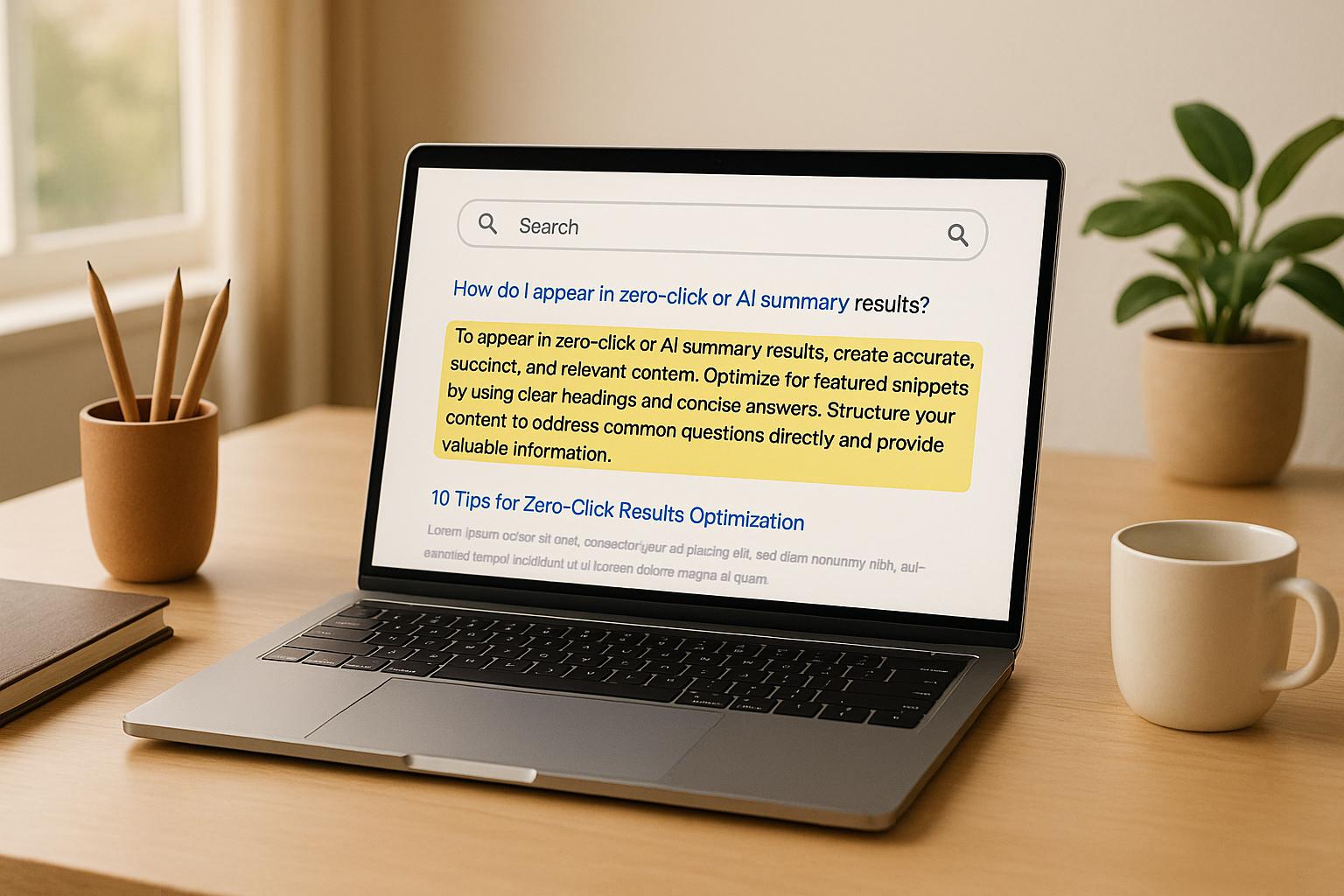

To show up in zero-click results or AI summaries, you need to create content that directly answers user questions, is easy to read, and aligns with search engine preferences. Here’s how you can do it:
- Answer Questions Clearly: Provide concise, direct answers within the first 40-50 words of each section. Use question-based headings that match user queries (e.g., "How long does it take to process a passport?").
- Structure Content for Scanning: Use bullet points, numbered lists, short paragraphs, and subheadings every 150-200 words. Include tables for comparisons when necessary.
- Add Schema Markup: Use tools like FAQ, HowTo, or Article schema to help search engines understand your content better.
- Focus on E-E-A-T: Ensure your content showcases experience, expertise, authority, and trust by citing credible sources, using accurate data, and sharing practical insights.
- Use Tools: Platforms like Google Search Console, SEMrush, and Ahrefs can help you identify zero-click opportunities and track performance.
How to Optimize for Zero Click Searches Strategies for 2024 | iCert Global

How to Structure Content for Zero-Click and AI Features
If you want your content to show up in zero-click results and AI summaries, you need to think carefully about how you organize and present the information. Search engines and AI tools are drawn to content that’s easy to extract and digest. Here’s how to create content that works for both users and AI.
Write Clear and Direct Answers
To land in zero-click results, your content must answer questions immediately and clearly. Search engines prioritize content that delivers direct responses within the first 40-50 words of a section.
For example, if someone searches, "How long does it take to get a passport?" your opening sentence should be something like: "A standard U.S. passport takes 6-8 weeks to process, while expedited processing takes 2-3 weeks." This type of clear and concise answer makes it easy for search engines to feature your content.
Use question-based headings to align with how people search. Instead of a generic heading like "Passport Processing", try "How Long Does Passport Processing Take?" This approach mirrors user queries and helps AI tools match your content to relevant searches.
Stick to specific and factual language. Avoid vague phrases like "it depends" unless you explain the variables in detail. AI tools favor content that includes precise figures, timelines, and clearly explained processes. If there are exceptions or variations, provide clear examples to make the information more useful.
Make Content Easy to Scan
Organizing your content for quick navigation is just as important as the answers themselves. Both search engines and AI tools prefer content that’s easy to scan, with a clear structure that highlights key points.
- Bullet points and numbered lists: These formats are ideal for zero-click results. Use numbered lists for step-by-step instructions and bullet points for simple lists. This makes it easier for algorithms to extract and display your information.
- Short paragraphs: Keep paragraphs to 2-3 sentences. Breaking up text into smaller chunks helps AI tools identify and extract relevant details more efficiently. Each paragraph should focus on just one idea.
- Subheadings every 150-200 words: Use descriptive subheadings with keywords to guide readers and search engines. This structure improves navigation and helps AI tools understand the context of your content.
- Tables for comparisons: When presenting comparisons or data, tables are highly effective. For example, searches like "iPhone vs Samsung features" or "mortgage rates by state" often pull directly from well-structured tables to create rich results.
Add Schema Markup to Your Content
To increase your content’s visibility, consider adding structured data like schema markup. This code helps search engines better understand your content’s context and purpose.
- FAQ schema: Marking up frequently asked questions allows search engines to display them directly in results as expandable sections. This not only improves visibility but also gives you multiple chances to appear for related searches.
- HowTo schema: For instructional content, this markup displays step-by-step guides in search results, often with details like required materials and estimated time. It’s especially useful for voice search and AI summaries.
- Article schema: This helps search engines identify key details like the publication date, author, and topic. Including this information boosts your content’s credibility and ensures it’s prioritized by AI tools, which often favor current, authoritative content.
- Local business schema: If you’re targeting location-based searches, this is essential. It ensures your business details – like hours, contact info, and services – appear in local search results and map listings.
You don’t need advanced technical skills to implement schema markup. Many content management systems, like WordPress, offer plugins such as Yoast SEO or RankMath that handle schema setup for you. These tools make it simple to add the right markup based on your content type.
Find Opportunities with Digital Tools
Digital tools can help uncover zero-click opportunities and measure how your content is performing. By combining these tools with smart content structuring, you can fine-tune your strategy to make the most of zero-click searches.
Track Performance with Google Search Console
Google Search Console is an essential resource for keeping tabs on zero-click performance. Its Performance report gives you a clear picture of how your content is showing up in search results, including instances where users find what they need without clicking through to your site.
For example, if you notice rising impressions but flat or declining clicks – like in the case of "The Great Decoupling" – it’s a sign that users are getting their answers directly from the search results page. Interestingly, only 18.6% of Google users "always or usually" click on source links found in AI Overviews.
The Search Appearance dimension in Google Search Console is another powerful tool. It highlights which SERP features your content appears in, such as Featured Snippets, FAQ-rich results, or AI Overviews. By analyzing click-through rates (CTR) across different query types, you can spot zero-click opportunities – especially when high impressions are paired with low CTR.
Keep an eye on the bigger picture, too. According to Semrush, zero-click searches make up 25.6% of desktop searches and 17.3% of mobile searches. These stats can guide adjustments to your content strategy to better align with user behavior.
Research Keywords with SEMrush and Ahrefs
Once you’ve assessed your current performance, tools like SEMrush and Ahrefs can help identify new zero-click opportunities. While Google Search Console focuses on your existing content, these platforms excel at pinpointing keywords that frequently trigger zero-click features before you even start creating.
They also provide detailed SERP analysis, helping you understand how zero-click features impact keyword performance. For instance, AI Overviews often favor content that’s well-structured and packed with context, even in highly competitive niches. This insight can shape how you approach content creation moving forward.
Build Authority for AI Summaries and Zero-Click Results
Establishing authority is all about creating content that both search engines and AI systems can trust. When Google’s algorithms assess content for zero-click results or AI-generated summaries, they prioritize reliability, accuracy, and usefulness. These factors help position your content for greater visibility in these features.
Apply E-E-A-T Principles (Experience, Expertise, Authority, Trust)
To strengthen your content’s credibility for zero-click results, focus on Google’s E-E-A-T framework (Experience, Expertise, Authority, Trust). This set of guidelines is considered the benchmark for high-quality content and plays a crucial role in how your material is evaluated for featured snippets and AI summaries.
- Experience: Share specific, first-hand knowledge. For example, if you’re writing about email marketing, include details like open rates you’ve achieved or A/B tests you’ve conducted. This kind of practical insight signals authenticity and makes your content more actionable for readers and AI systems alike.
- Expertise: Go beyond surface-level knowledge by diving deep into your subject. Use precise terminology, reference current standards, and back up your points with the latest data. When explaining technical topics, aim to strike a balance – make them accessible without oversimplifying. AI systems often prioritize content that pairs depth with clarity.
- Authority: Build authority by consistently producing high-quality content and earning recognition from reputable sources. Mentions in industry publications, backlinks from established websites, and citations by other experts all contribute to your authority. These external signals help AI systems determine that your content is worth highlighting.
- Trust: Trustworthiness comes from accuracy and transparency. Always fact-check your claims, keep information up-to-date, and clearly cite your sources. For example, when referencing statistics or trends, link directly to the original research. This level of transparency not only builds user confidence but also helps AI systems verify your content quickly.
The key is to integrate these principles naturally into your writing. Instead of overloading your content with credentials, let your expertise shine through in the depth and quality of your insights. AI systems are becoming increasingly adept at distinguishing genuine authority from superficial claims.
Once you’ve established trust, focus on making your content resonate with your target audience.
Customize Content for U.S. Audiences
To connect with U.S. readers and improve your chances of appearing in zero-click results, it’s essential to tailor your content to their preferences, behaviors, and cultural context.
Start by meeting the technical expectations for U.S.-specific content. Use dollar signs ($) for pricing, format dates as MM/DD/YYYY (e.g., 08/18/2025), and prioritize imperial measurements like miles and Fahrenheit. These small details align with U.S. search norms and make your content feel more relatable.
Cultural context is just as important. American audiences tend to favor direct, actionable language. Instead of using phrases like “one might consider,” opt for more straightforward alternatives like “you should” or “try this approach.” This style aligns better with how Americans search and engage with content.
When writing about business or regulatory topics, cater to U.S. standards. Mention federal guidelines and highlight that specific rules may vary by state. For example, if you’re discussing business hours, reference U.S. time zones such as EST or PST. This level of detail helps your content perform better in location-specific zero-click results.
Seasonal and cultural events also play a role in connecting with U.S. readers. Incorporate references to major holidays, back-to-school periods, or tax season when relevant. These touchpoints not only make your content more engaging but also help AI systems recognize its relevance to American users.
Finally, stick to American spelling conventions (e.g., “optimize” instead of “optimise” and “color” rather than “colour”).
sbb-itb-939d0c4
Zero-Click Features Comparison and Benefits
Building on the strategies we’ve discussed, let’s dive into a comparison of key zero-click features and their benefits. Understanding the nuances of these features can help you prioritize your efforts and allocate resources where they’ll have the most impact. Each type of zero-click feature offers unique advantages and requires tailored approaches to maximize visibility.
Types of Zero-Click Features
Featured snippets are the crown jewels of zero-click visibility. Positioned at the very top of search results, they provide quick, authoritative answers to user queries, significantly boosting brand visibility. These snippets come in three formats: paragraphs for "what is" or "why" questions, lists for step-by-step instructions, and tables for comparing data.
People Also Ask (PAA) boxes are dynamic features that expand as users click on related questions. They offer multiple chances to appear on a single search results page, creating a ripple effect of visibility as users explore related topics.
Knowledge panels provide structured information about entities such as businesses, people, or organizations. While harder to influence directly, these panels establish strong brand authority when your business details – like hours, contact information, or key facts – are prominently displayed.
Local packs are critical for location-based searches, showcasing three businesses alongside a map. These are especially valuable for brick-and-mortar stores and service providers targeting local customers. Local packs often include review ratings, business hours, and direct call options, making them a powerful tool for driving customer actions.
Image packs and video carousels cater to the growing demand for visual content. These features are particularly useful for industries like fashion, food, and home improvement, where visuals play a key role in user engagement.
The table below provides a clear comparison of these features, helping you decide where to focus your optimization efforts based on visibility, complexity, and potential brand impact.
Zero-Click Features Comparison Table
| Feature Type | Visibility Potential | Optimization Ease | Impact on Brand Awareness | Best for Business Type |
|---|---|---|---|---|
| Featured Snippets | High | Moderate | Strong | Content-heavy businesses, SaaS, education |
| People Also Ask | Moderate | Easy | Moderate | Service providers, consultants, how-to content |
| Knowledge Panels | High | Difficult | Very Strong | Established brands, public figures, large companies |
| Local Packs | High | Moderate | Strong | Local businesses, restaurants, service providers |
| Image Packs | Moderate | Easy | Moderate | E-commerce, visual products, creative services |
| Video Carousels | Moderate | Moderate | Strong | Entertainment, education, product demos |
Key Insights from the Table
- Visibility potential shows how prominently each feature appears in search results. Featured snippets and knowledge panels dominate prime screen space, while PAA boxes and image packs still offer valuable visibility.
- Optimization ease reflects the effort required to target each feature. For example, PAA boxes are relatively simple to optimize through straightforward Q&A content, while knowledge panels demand building authority across multiple platforms.
- Brand awareness impact highlights how effectively each feature enhances trust and recognition. Knowledge panels and featured snippets are particularly powerful for establishing credibility, while local packs excel at driving direct actions like phone calls or visits.
A Multi-Feature Strategy
The best results often come from combining multiple zero-click features rather than focusing on just one. For example, a local restaurant might target local packs to attract nearby customers, optimize PAA boxes for cooking-related queries, and use image packs to showcase mouthwatering food photography. This layered approach creates multiple entry points for potential customers to discover your business.
Your industry and resources should guide your priorities. B2B software companies might focus on featured snippets and PAA boxes, while retail businesses could see better returns from image packs and local optimization. Tailoring your strategy to your unique goals and capabilities ensures you’re making the most of these powerful tools.
Conclusion: Key Steps for Zero-Click and AI Summary Optimization
Navigating the world of zero-click and AI summary optimization requires a smart mix of technical know-how and high-quality content. As search trends shift, businesses that fine-tune their strategies now can position themselves to grab user attention more effectively.
Review of Optimization Methods
At the heart of zero-click success is crafting content that directly and concisely answers user questions. Search engines and AI systems prioritize clear, authoritative responses that align with user intent.
Schema markup plays a crucial role here. By embedding structured data for things like articles, FAQs, how-to guides, or local business details, you make it easier for search engines to understand and potentially highlight your content. While schema markup doesn’t guarantee placement in rich results, it significantly improves your chances.
Then there’s E-E-A-T (Experience, Expertise, Authoritativeness, and Trustworthiness), which helps establish the credibility that search engines value. This means showcasing author qualifications, citing reliable sources, and maintaining consistent quality across your content.
Tools like Google Search Console, SEMrush, and Ahrefs are invaluable for this process. Search Console can reveal which queries already trigger zero-click features, while keyword research tools can uncover fresh opportunities for featured placements.
Finally, the way you format your content matters. Use clear headings, bullet points, and numbered lists to make your content easy to read and digest. This approach not only helps users but also allows AI systems to extract information more effectively.
By following these strategies, you’ll be well-prepared to take advantage of zero-click opportunities.
Action Steps for Your Business
Start by auditing your current content. Look for pages that already rank on the first page of search results but aren’t capturing zero-click features. These are low-hanging fruit – content that’s already performing well but might need adjustments to secure featured snippets or People Also Ask placements.
Next, focus your efforts based on your business type. If you’re a local business, ensure your local pack elements and knowledge panel information are accurate and optimized. For content-heavy businesses, aim for featured snippets and People Also Ask boxes to gain visibility with relatively minimal tweaks.
Consider building a content calendar specifically aimed at zero-click opportunities. Research the common questions your audience is asking and create detailed, well-structured answers tailored to these queries. Publishing optimized content regularly signals to search engines that your site is both active and reliable.
Lastly, keep an eye on your progress using tools like those mentioned earlier. Zero-click optimization isn’t a one-and-done task – it’s an ongoing effort that requires you to adapt as search algorithms and AI systems continue to evolve. By staying proactive, you can ensure your content remains competitive in this rapidly changing landscape.
FAQs
How can I optimize my content to meet E-E-A-T standards and appear in zero-click results?
To improve your chances of showing up in zero-click search results, focus on aligning your content with E-E-A-T principles: experience, expertise, authoritativeness, and trustworthiness. Aim to create clear, concise answers that directly address common questions and match the intent behind the search. This makes your content more likely to be featured in snippets or AI-generated summaries.
Incorporate tools like schema markup to help search engines interpret your content more effectively. Accuracy and clarity should always be a top priority in your writing. Additionally, keep your content up-to-date to maintain its relevance and credibility. By consistently providing reliable and well-structured information, you can increase your visibility in zero-click search results.
What mistakes should I avoid when optimizing content for AI summaries and zero-click results?
How to Avoid Common Mistakes When Optimizing for AI Summaries and Zero-Click Results
If you’re aiming to get your content featured in AI summaries or zero-click search results, avoiding these frequent pitfalls is key:
- Disorganized content structure: Make sure your content is easy to navigate. Use clear headings, break information into concise paragraphs, and include properly formatted FAQs. When content is chaotic, AI struggles to pull out the most important details.
- Skipping schema markup: Structured data is your friend. Without schema markup, search engines may have trouble understanding your content, which can keep it out of knowledge panels or featured snippets.
- Failing to provide direct answers: Don’t dance around the point. Offer straightforward, concise, and well-informed answers to common questions. This helps address user intent and makes it easier for AI to identify your content as a reliable source.
By focusing on clear organization, precise answers, and technical tweaks like schema markup, you’ll boost your chances of standing out in AI-generated summaries and zero-click results.
How can I use tools like Google Search Console and SEMrush to optimize for zero-click search results?
To make the most of zero-click search results, tools like Google Search Console and SEMrush can be game-changers. In Google Search Console, keep an eye on your impressions and average position to spot keywords that trigger features like AI-generated summaries or featured snippets. These are often the driving force behind zero-click results, and focusing on them can significantly increase your visibility.
With SEMrush, you can monitor how your content performs in these features and identify high-potential keywords. Armed with this data, you can fine-tune your content by adding structured data, providing clear and authoritative answers, and keeping your information concise and well-organized. Regularly updating and improving your content will boost your chances of landing in these prominent SERP features, ensuring you grab your audience’s attention effectively.
Related Blog Posts
- How can I recover my website’s lost organic traffic after Google’s AI Overview update?
- What can I do to prevent my business from losing customers to AI-generated search results?
- How can I get my brand featured in AI-generated answers rather than ignored?
- Is traditional SEO dead because of AI search? What should I do now?
