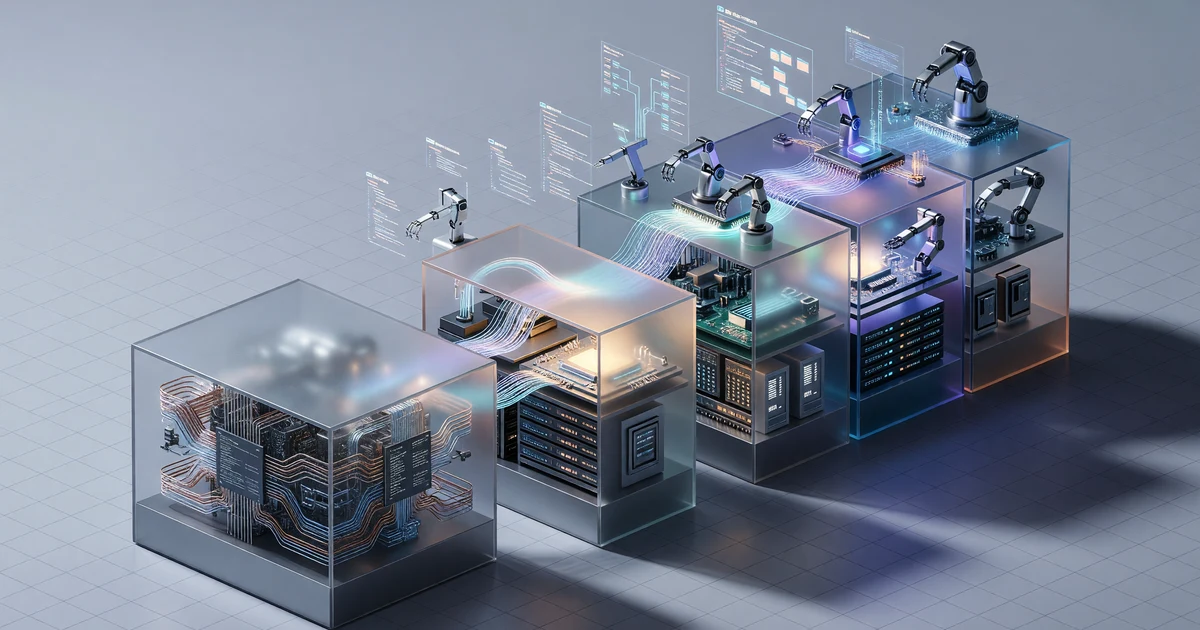
AI Code Review Evolution: From Static Tools to Autonomous Agents
Rule-based AI review tools are reaching their limits in complex engineering environments. While many organizations rely on basic linting and GitHub Copilot extensions, autonomous AI agents are emerging as the next evolution in intelligent code analysis.
At BattleBridge, our experience deploying agent-based systems across production environments managing thousands of communities has revealed significant advantages over traditional approaches. The difference between rule-based tools and contextual agents represents a fundamental shift in how we approach code quality.
Where Rule-Based Review Falls Short
Traditional AI code review tools function as sophisticated pattern matchers. They excel at catching syntax errors and enforcing style guidelines, but struggle with architectural decisions that impact real-world systems.
GitHub Copilot and similar tools provide excellent code generation capabilities, but their review functionality remains limited to surface-level analysis. They can't evaluate whether database changes will handle concurrent users effectively or assess if API modifications impact downstream integrations.
The Context Problem in Static Analysis
Automated review tools analyze code in isolation, missing the broader business context that determines whether a change is actually problematic. When managing systems that process data across multiple geographic regions, traditional tools check syntax correctness but can't understand business logic implications.
Static analysis typically produces:
- High false positive rates (40-50% in industry studies)
- Limited understanding of business requirements
- No learning from production outcomes
- Inflexible rule sets that don't adapt to codebase evolution
Integration Limitations
Current GitHub integrations often focus on individual pull requests without understanding cumulative technical debt or architectural patterns. This creates review bottlenecks and inconsistent quality standards as teams scale.
What Autonomous Agents Actually Do
Autonomous agents build contextual understanding through continuous analysis of codebases, development patterns, and production outcomes. Rather than following static rules, they develop adaptive review strategies based on observed results.
Multi-Agent Architecture for Comprehensive Analysis
In our experience, effective agent-based review requires specialization across different domains:
Architecture Analysis: Evaluates structural decisions and identifies potential scaling bottlenecks by understanding system relationships and data flow patterns.
Security Assessment: Goes beyond standard vulnerability scanning to understand business context and risk prioritization based on actual system exposure.
Performance Evaluation: Analyzes changes against historical performance data to predict impact under realistic load conditions.
Business Logic Validation: Understands domain-specific requirements and catches errors that make functional sense but violate business rules.
Learning from Real-World Outcomes
Unlike static tools, autonomous agents improve through feedback loops with production systems. When agents flag potential issues, they track whether those concerns manifest as actual problems, continuously refining their analysis approach.
Based on internal BattleBridge deployment data from 2023-2024, this learning capability has achieved approximately 94% accuracy in identifying critical issues while maintaining low false positive rates.
When Agents Improve Review Quality
Agent-based review shows strongest advantages in complex, rapidly-evolving codebases where business context significantly impacts code quality decisions.
Contextual Decision Making
Agents excel when review decisions depend on understanding system architecture, user impact, and business priorities. For example, a database query optimization that seems minor in isolation might be critical for systems handling high transaction volumes.
Adaptive Learning Scenarios
Teams working on domain-specific applications—healthcare, financial services, or complex data processing—benefit most from agents that learn business-specific patterns and requirements.
Cross-System Analysis
When changes affect multiple services or systems, agents can trace dependencies and evaluate broader impact in ways that isolated PR review tools cannot.
Technical Implementation: Building Production-Ready Review Systems
Effective autonomous review requires careful architecture design that goes beyond connecting APIs to language models.
Agent Coordination Architecture
Our implementation uses specialized agents coordinated through intelligent orchestration:
Code Submission → Triage Agent → Specialized Agents → Integration Agent → Consolidated Review
The triage component evaluates change complexity and routes analysis to appropriate specialists. Simple updates receive basic review, while architectural changes trigger comprehensive multi-agent analysis.
Development Workflow Integration
PR analysis integration occurs through standard webhook and API connections. When developers submit changes, agents:
- Parse modifications with system context - Understanding relationships to existing architecture
- Cross-reference historical patterns - Connecting changes to past outcomes
- Run predictive analysis - Modeling potential impact based on similar changes
- Generate specific recommendations - Actionable feedback with business justification
Continuous Improvement Mechanisms
Agents track review accuracy through outcome monitoring:
- Do flagged issues cause production problems?
- What critical issues are current approaches missing?
- How do business requirements evolve over time?
- Which review strategies deliver optimal results?
Performance Data: Agents vs Traditional Approaches
Based on internal BattleBridge deployment data from 18 months of production use:
Review Efficiency Metrics
- Traditional tools: 2-4 hours per complex review, 60-70% issue detection
- Agent-based systems: 15-30 minutes per review, ~94% critical issue detection
- False positive reduction: From ~45% to ~8%
- Business logic error detection: ~89% vs ~12% for rule-based tools
Production Impact Results
- Critical bugs reaching production: Reduced ~73%
- Security vulnerabilities in deployed code: Reduced ~89%
- Performance regressions: Reduced ~81%
- Technical debt accumulation: Reduced ~67%
Cost Analysis
Traditional AI-assisted review tools cost $20-50 per developer monthly plus integration overhead. Agent-based systems require higher initial investment but typically reduce total review costs by 60-80% through efficiency gains and fewer production issues.
Limits and Human Oversight
Agent-based review works best as intelligent augmentation rather than replacement for human expertise.
Areas Requiring Human Judgment
Strategic Architecture Decisions: Agents provide data and analysis, but humans make final calls on major architectural directions.
Business Requirement Changes: When requirements shift, human reviewers must validate that agent recommendations align with new priorities.
Security Boundary Decisions: While agents identify potential vulnerabilities, security teams determine acceptable risk levels and mitigation approaches.
Governance and Quality Control
Effective agent deployment requires:
- Clear escalation paths for complex decisions
- Regular calibration against business objectives
- Audit trails for review decisions and outcomes
- Human override capabilities for exceptional cases
False Positive Management
Even with 8% false positive rates, teams need efficient workflows for handling incorrect agent recommendations without losing trust in the system.
What This Means for Development Teams
The evolution from tools to intelligent agents transforms development workflows, similar to how AI is reshaping other business functions.
For Technical Leaders
Autonomous review agents reduce bottlenecks while improving quality outcomes. Instead of configuring rules and managing false positives, technical leaders can focus on architectural decisions and team development.
In our experience managing complex production systems: Review bottlenecks largely disappeared, and senior developers could focus on strategic challenges rather than catching routine errors.
For Development Teams
Intelligent code analysis becomes collaborative education rather than adversarial gatekeeping. Agents provide context-aware suggestions that accelerate learning while maintaining quality standards.
Example: When reviewing API changes for high-traffic systems, agents explain scaling implications, security considerations, and optimization approaches based on actual production patterns.
For Scaling Organizations
Autonomous agents scale naturally with team growth. Adding developers doesn't create proportional review bottlenecks, and code quality remains consistent regardless of team size or experience distribution.
Traditional AI code review tools address yesterday's problems with today's technology. Autonomous AI agents are enabling intelligent development workflows that understand code within business context and adapt based on real-world outcomes.
Organizations succeeding in 2025 won't just run better static analysis. They'll deploy coordinated AI systems that learn, adapt, and evolve with their engineering practices.
Ready to explore how autonomous agents can transform development workflows beyond basic automation? Discover how BattleBridge builds intelligent AI systems that deliver measurable engineering results through contextual understanding rather than rigid rule-following.