---
title: "AI Marketing for Nonprofits: Enterprise Results on a Shoestring Budget"
description: "Nonprofits can deploy autonomous AI marketing agents for under $500/month and outperform organizations spending 10x more. Here's exactly how."
date: "2026-04-29"
author: "Travis Phipps"
keywords: ["ai marketing nonprofits", "nonprofit [marketing automation](/blog/multi-agent-systems-for-marketing-why-one-ai-isn-t-enough)", "[agentic marketing](/blog/what-is-agentic-marketing-the-complete-guide-for-2026) nonprofit", "ai content agent nonprofit", "nonprofit seo automation"]
pillar: "agentic-marketing"
slug: "ai-marketing-for-nonprofits-enterprise-results-on-a-shoestring-budget"
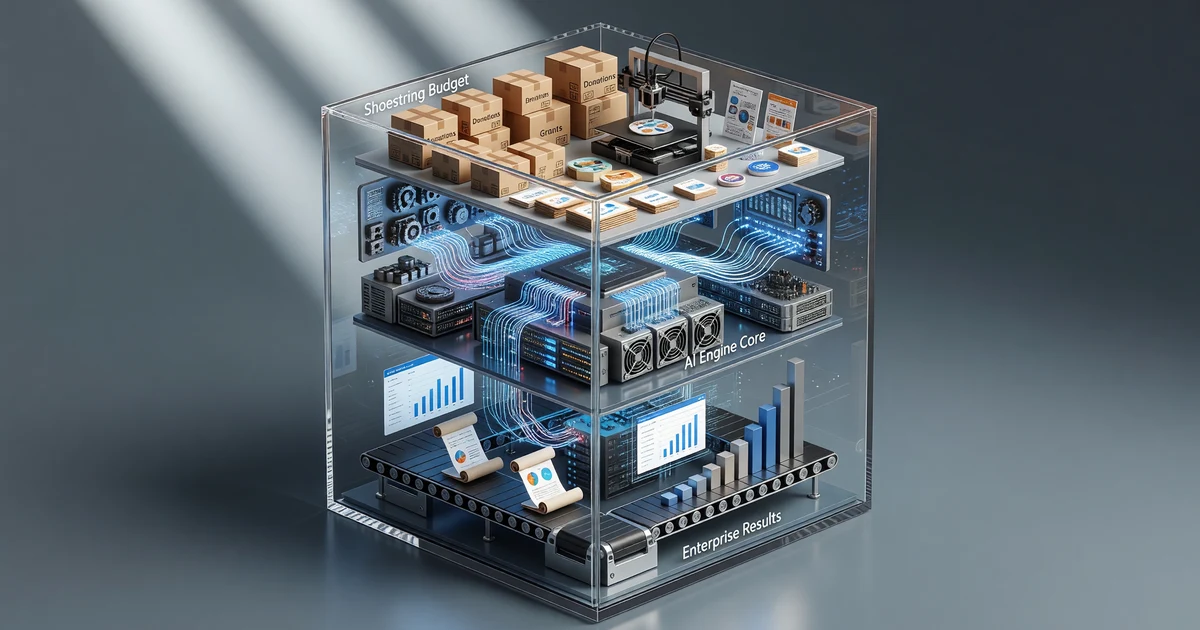
imageAlt: "AI marketing for nonprofits — dashboard showing autonomous agent activity generating content, SEO pages, and donor outreach at scale for a small nonprofit team"
summary: "AI marketing for nonprofits means deploying autonomous agents that handle SEO, content, and donor outreach around the clock — without agency retainers or large staff. Organizations running agentic systems can generate hundreds of location-specific pages, maintain consistent content output, and manage thousands of donor contacts for under $500/month. The constraint isn't budget; it's knowing which systems to build first."
faq:
  - q: "How much does AI marketing cost for a nonprofit?"
    a: "A functional agentic marketing stack — SEO agent, content agent, and basic CRM automation — runs $200–$500/month in infrastructure and API costs. That's model API fees, a VPS or two, and tooling. You're not paying agency retainers or full-time salaries for this work."
  - q: "Can AI marketing actually work for small nonprofits with no tech team?"
    a: "Yes, but the setup requires someone technically capable upfront — either a founder, a contractor, or a partner agency. Once the agents are running, they operate autonomously. The ongoing management load is light: maybe 2–3 hours/week of review and steering."
  - q: "What's the difference between AI marketing tools and AI marketing agents for nonprofits?"
    a: "Tools (like Jasper or Surfer) require a human to operate them every time. AI marketing agents for nonprofits run on their own — they generate content, publish it, monitor rankings, and trigger follow-up actions without anyone pressing a button. Agents compound; tools require labor."
  - q: "How do nonprofits use AI agents for donor outreach?"
    a: "The most effective approach is building a contact database first — scraped from public sources, imported from past campaigns, or enriched from event sign-ups — then using an agent to segment, personalize, and sequence outreach. We built an 8,442-contact CRM this way without Salesforce or HubSpot."
  - q: "What results can a nonprofit realistically expect from AI marketing in the first 90 days?"
    a: "In 90 days, a well-configured agentic system can produce 50–200 indexed pages, establish a baseline content cadence, and begin generating organic traffic. SEO compounds slowly, so month 3 traffic will be modest — but the infrastructure you're building pays off in months 6–18 with minimal additional cost."
---

Nonprofits can run enterprise-scale marketing operations for under $500/month using autonomous AI agents — no agency retainer, no full-time marketing staff, no compromise on output quality. The gap between what large organizations spend on marketing and what they actually receive for it is where agentic systems create the most leverage.

We've built these systems in production. Our SEO agent generated 977 city-specific pages across 51 states for a senior living directory — autonomously. Our CRM agent manages 8,442 contacts without Salesforce or HubSpot. The same architecture maps cleanly to nonprofit constraints: tight budget, small team, high content volume requirements, and a donor base that responds to specificity. Here's how to build it.

---

## Why the [Traditional Agency](/blog/ai-marketing-agency-vs-traditional-agency-the-real-difference-in-2026) Model Fails Nonprofits

The standard nonprofit marketing playbook — hire an agency, pay a retainer, get monthly reports — was designed for organizations with marketing budgets north of $10,000/month. For nonprofits operating on $1,500–$3,000/month in marketing spend, you're paying for the agency's overhead, not their output.

The [true cost of a traditional marketing agency](/blog/the-true-cost-of-a-marketing-agency-in-2026-agency-vs-ai-vs-in-house) includes account management, internal coordination, tooling markups, and margin — before a single piece of content gets written. A mid-tier agency charges $150–$250/hour for work that an agent executes at fractions of a cent per token.

The alternative isn't "do it yourself with ChatGPT." That's still labor-intensive, still human-gated, and still doesn't scale. The alternative is deploying autonomous agents that run 24/7 without your involvement.

### What Nonprofits Actually Need From Marketing

Before building anything, map what your organization actually requires:

- **Awareness**: People need to find you before they donate or volunteer. This is an SEO and content problem.
- **Trust**: Donors and partners want evidence of real work — specific numbers, named programs, documented outcomes. This is a case study and specificity problem.
- **Conversion**: Moving people from "I've heard of you" to "I gave/signed up/volunteered." This is a follow-up and nurture problem.

Agentic systems address all three — but the build order matters. Start with awareness infrastructure (SEO), then trust assets (content), then conversion automation (CRM and outreach sequences).

---

## Building Your SEO Foundation With an Autonomous Agent

The highest-leverage marketing investment for most nonprofits is organic search. When someone types "food bank [city]" or "youth mentorship programs [state]," you want to appear. Ranking for those terms requires pages — hundreds of them, each targeting a specific location and intent.

Building that manually takes months and a full-time writer. An SEO agent does it in days.

We documented exactly how this works in our [programmatic SEO case study](/blog/how-our-seo-agent-generated-977-city-pages-in-51-states-programmatic-seo-at-scale): our agent generated 977 city-specific pages across 51 states for a senior living directory. Each page was unique, indexed, and optimized. No human wrote a single one.

The same architecture works for a nonprofit. If you serve veterans in 40 cities, you need 40 location pages. If you provide after-school programs across a metro area, you need neighborhood-level content. An SEO agent produces all of it from a structured dataset and a content template.

### What an SEO Agent Actually Does

A well-configured SEO agent:

1. Pulls from a geographic or topical dataset (cities, zip codes, service categories)
2. Generates unique, optimized content for each combination
3. Publishes pages to your CMS or static site
4. Monitors rankings and triggers refreshes when pages slip
5. Surfaces new keyword opportunities from Search Console data

The [difference between SEO agents and SEO tools](/blog/ai-seo-agents-vs-seo-tools-why-agents-win-for-growing-businesses) is autonomy. Tools require a human operator every time. Agents run on a cron schedule and escalate to humans only when they encounter something outside their parameters.

### Real Infrastructure Costs

For a nonprofit running a regional SEO program:

| Component | Monthly Cost |
|-----------|-------------|
| Claude API (content generation) | $80–$150 |
| VPS for agent runtime | $20–$40 |
| Google Search Console API | Free |
| CMS hosting | $10–$30 |
| **Total** | **$110–$220/month** |

No retainer. No markup. The agent runs nights and weekends with no overtime cost.

---

## Content at Scale: Running a Content Agent on a Nonprofit Budget

Consistent content output is where most nonprofits fail. You have a mission-driven story to tell, but the people who should be writing it are running programs, managing volunteers, and chasing grants. Content becomes an afterthought.

An AI content agent changes the constraint. Instead of "do we have bandwidth to write this," the question becomes "what do we want the agent to produce this week?"

A content agent handles blog drafts, case study outlines, email copy, and social post variations — all queued from a content calendar and executed autonomously. A human reviews and publishes; the agent does the drafting. That ratio means one staff member can manage the output of what used to require a three-person content team.

### Prioritize These Content Types First

Not all content delivers equal return. For nonprofits, build in this order:

**1. Impact stories with specific numbers**
"We served 847 families last year" outperforms "we helped hundreds of families" for both donor trust and search relevance. Agents can pull from your program data and draft impact reports, annual summaries, and donor updates at scale.

**2. Location-specific program pages**
If you operate across multiple neighborhoods, cities, or counties, each location needs its own page. This is both an SEO play and a trust signal for local donors and funders.

**3. FAQ and resource content**
Questions your constituents ask repeatedly — "how do I apply for services," "what documents do I need," "what are your hours" — should live as indexed, searchable pages. Agents generate these from your existing intake documentation in hours, not weeks.

**4. Donor-facing case studies**
Third-party validation drives donations more than mission statements. Agents draft case study templates; staff fills in the program-specific details; the agent reformats for web, email, and social.

For a deeper look at deploying this kind of system, see our [AI content agent playbook](/blog/deploy-an-ai-content-agent-for-your-business-the-complete-playbook).

---

## Donor CRM Without Salesforce or HubSpot

The nonprofit CRM market is structured against small organizations. Salesforce Nonprofit charges thousands per year. HubSpot's nonprofit discount still lands at $400–$800/month for anything beyond basic contact management. Bloomerang, Little Green Light, and Kindful all require manual data entry, manual imports, and human-driven follow-up sequences.

We built an 8,442-contact CRM using AI agents — [no Salesforce, no HubSpot](/blog/building-a-crm-with-8-442-contacts-using-ai-agents-no-salesforce-no-hubspot). The system ingests contacts from multiple sources, deduplicates, enriches with public data, segments by engagement and geography, and triggers outreach sequences automatically.

For a nonprofit, this architecture handles:

- **Donor lifecycle management**: First-time givers receive a different sequence than recurring donors or lapsed donors. The agent segments and routes without staff involvement.
- **Volunteer coordination**: Event sign-ups trigger confirmation, reminder, and post-event follow-up sequences automatically.
- **Grant prospect research**: A research agent pulls public foundation data, matches it against your program focus areas, and surfaces high-probability grant opportunities ranked by fit.
- **Re-engagement campaigns**: Contacts who haven't engaged in 90+ days receive a targeted re-engagement sequence, not the same newsletter everyone else gets.

### Cost Comparison: Custom Agentic CRM vs. Commercial Platforms

| System | Annual Cost | Setup Time |
|--------|------------|------------|
| Salesforce Nonprofit | $3,600–$12,000 | 3–6 months |
| HubSpot (nonprofit rate) | $4,800–$9,600 | 1–2 months |
| Custom agentic CRM | $600–$1,200 | 4–8 weeks |

The custom system requires real technical work upfront. But once it's running, you own it outright, there are no seat limits, and it executes tasks that commercial CRMs can't — because it's built around how your organization actually operates, not a generic SaaS template.

---

## The Agentic Marketing Stack for Nonprofits: Build Order

Don't try to build everything simultaneously. Sequence determines whether you succeed.

**Month 1–2: SEO Foundation**
Get location and program pages built and submitted to Search Console. This is the highest-leverage move because organic search compounds. Every week you delay is a week of lost ranking potential that you can't recover.

**Month 2–3: Content Agent**
Once you have pages driving traffic, you need content to keep visitors engaged and to target mid-funnel keywords. Stand up a content agent producing 4–8 pieces per month on a defined calendar.

**Month 3–4: Contact Database and CRM**
Import every contact you have — past donors, event attendees, email subscribers, volunteer applications. Clean, deduplicate, and segment. This is your outreach foundation; nothing downstream works without it.

**Month 4–6: Outreach Sequences**
Build automated sequences for your key segments. Start simple: a 3-email sequence for new donors, a 3-email re-engagement sequence for contacts who haven't given in 12+ months.

**Month 6+: Add Layers**
With the foundation running, add GEO optimization (ranking in AI search engines like Perplexity and ChatGPT — see our [GEO guide](/blog/generative-engine-optimization-geo-how-to-rank-in-chatgpt-perplexity-and-ai-search)), social content agents, and grant research automation.

This is what [agentic marketing](/blog/what-is-agentic-marketing-the-complete-guide-for-2026) looks like in practice: not a single tool, but a coordinated system of agents that handle different parts of the funnel and hand off to each other without human coordination. For the technical blueprint, see [the architecture of an agentic marketing system](/blog/the-architecture-of-an-agentic-marketing-system-how-we-built-10-autonomous-ai-agents) — the same 10-agent system we run in production scales down to nonprofit budgets without losing the core logic.

---

## Realistic Timelines: What to Expect and When

No agentic system produces overnight results. Here's an honest projection for a nonprofit starting from scratch:

**Days 1–30**: Infrastructure live. Pages published and submitted to Search Console. Content agent producing first assets. No meaningful traffic yet — this phase is foundation-setting, not results-generating.

**Days 30–60**: First organic impressions appearing in Search Console. 10–30 pages indexed. Content cadence established. Agent running autonomously with 2–3 hours/week of human review.

**Days 60–90**: Organic traffic beginning — expect 100–500 sessions/month depending on keyword competition in your geography and how many pages you published. Donor outreach sequences live with first automated sends.

**Months 3–6**: Traffic compounding. Top pages reaching page 2–3 for target keywords. CRM sequences generating measurable re-engagement. Monthly infrastructure cost holding at $300–$500.

**Months 6–12**: Established organic presence. Location pages ranking for local queries. Email list growing from organic traffic. Measurable donation attribution tied to search entries.

This is slower than paid advertising and faster than manual SEO. The difference is the cost structure: once the system is running, the marginal cost of additional output is near zero. A paid campaign stops producing the moment you stop paying. An agentic content foundation keeps compounding.

---

## The Bottom Line for Nonprofits Considering AI Marketing

AI marketing for nonprofits isn't a tool you buy — it's a system you build. The organizations that will own their local search results and donor mindshare over the next three years are the ones building agentic infrastructure now, not waiting for it to become plug-and-play.

The budget barrier is lower than you think. A full stack — SEO agent, content agent, and CRM automation — runs $300–$500/month. The technical barrier is real but surmountable with the right partner. And the competitive advantage over nonprofits still paying agency retainers for manual work is significant and durable.

The closest public example of what's possible at scale is the [USR case study](/blog/case-study-how-we-took-a-senior-living-directory-from-invisible-to-4-757-community-listings): a senior living directory that went from invisible to 4,757 indexed [community listings](/blog/case-study-how-we-took-a-senior-living-directory-from-invisible-to-4-757-community-listings) across 51 states using autonomous agents. That's the architecture, running in production, available now.

Stop thinking about marketing as something your staff squeezes in between real work. Build machines that do it while your team focuses on the mission.

---

**Ready to build your nonprofit's marketing machine?** [Talk to BattleBridge](/). We build agentic systems for organizations that can't afford to waste budget on retainers that don't compound — and we've done it at scale.
2026 04 29 ai marketing for nonprofits enterprise results on a shoestring budget
Travis Phipps | | 12 min read