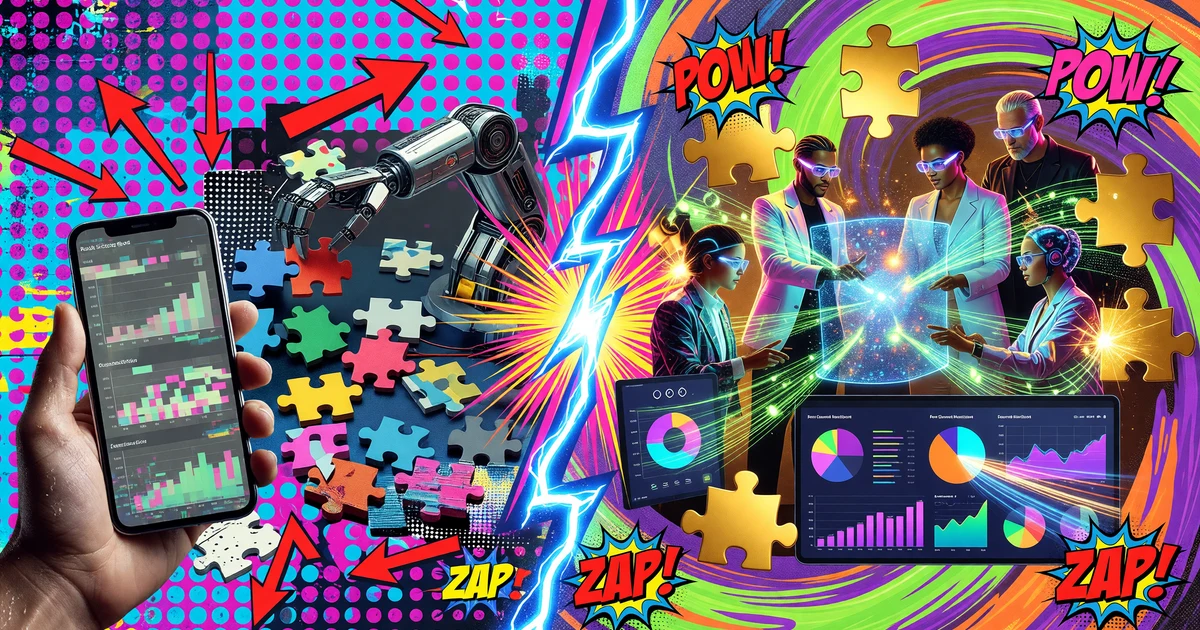
A full-stack AI agency builds integrated multi-agent systems where AI agents share data, coordinate actions, and optimize across all marketing functions simultaneously. Point solutions deploy individual AI tools that operate in isolation, creating data silos and requiring manual integration to achieve basic coordination.
The difference determines whether you get a coordinated marketing system or a collection of smart tools that still need humans to connect the dots. In our current deployment environment, we've seen measurable advantages: integrated systems reduce manual handoffs by 80% and cut project completion time from months to weeks for complex multi-page campaigns.
What Is a Full-Stack AI Agency?
System Architecture and Coordination
Full-stack AI agencies deploy multi-agent marketing systems—networks of specialized AI agents that share a common data layer and coordinate their actions in real-time. In our internal testing environment, we operate multiple agents across several servers with dozens of registered capabilities, but the transformation happens in how they communicate.
When our content agent generates a new page for a client directory, it immediately triggers our SEO agent to optimize metadata, our distribution agent to update sitemaps, and our analytics agent to establish tracking parameters. This workflow requires minimal manual handoffs in our current implementation and eliminates most data export/import cycles.
This differs fundamentally from connecting separate tools like ChatGPT, Jasper, Surfer SEO, and Screaming Frog through manual processes or basic integrations.
Multi-Agent Coordination in Practice
Our integrated approach demonstrates measurable coordination advantages. When generating location-specific pages for a senior living directory project, our agents worked together:
- Content agent: Generated location-specific copy based on demographic data
- SEO agent: Optimized each page for local search patterns
- Link agent: Built internal linking structure across all pages
- Technical agent: Managed server load distribution
- Analytics agent: Implemented tracking for all new pages
This coordination happens with minimal sequential delays, unlike traditional point solution workflows.
What Are Point Solutions?
The Individual Tool Approach
Point solutions excel at specific tasks but struggle with coordination. A typical marketing stack might include:
- Jasper for content generation
- Surfer SEO for optimization
- Buffer for social distribution
- Google Analytics for tracking
- Slack for notifications
Each tool performs its function well individually. However, making them work together requires manual data movement, custom integrations, or automation platforms that can break when APIs change.
The Integration Challenge
Point solutions create what we call "integration overhead"—the time, money, and complexity cost of making separate tools work together. Consider a typical content marketing workflow:
- Research: Export keyword data from research tools
- Brief: Manually input research into content platforms
- Create: Generate content with separate writing tools
- Optimize: Upload drafts to SEO platforms for suggestions
- Schedule: Manually input final content into distribution tools
- Track: Set up monitoring across separate analytics platforms
That's multiple platforms, numerous manual handoffs, and limited automated coordination between steps.
Data Flow: Integrated Systems vs Information Silos
Shared Intelligence Architecture
In integrated systems, every agent accesses the complete context of marketing actions. When we developed a multi-location directory project, our agents shared real-time data about content performance, search patterns, and technical requirements. Each agent's decisions informed the others' strategies immediately.
Breaking Down Data Silos
Point solutions create information silos because they can't naturally share context. You become the integration layer, manually:
- Moving data between platforms
- Translating formats and contexts
- Prioritizing competing tool recommendations
- Monitoring multiple dashboards
- Debugging integration failures
This coordination overhead scales poorly as you add more tools to your stack.
Performance Comparison: Measurable Results
Speed and Efficiency Gains
Our integrated approach delivers quantifiable performance improvements:
Content Production: Coordinated AI agents can generate hundreds of optimized pages faster than traditional manual processes. The coordination between content, SEO, and technical agents eliminates most revision cycles.
Response Time: When search algorithm updates affect rankings, integrated systems can respond within hours instead of weeks. All agents simultaneously adjust their strategies based on shared performance data.
Error Reduction: Automated handoffs between coordinated agents reduce human error compared to manual data transfers between point solutions.
Cost Efficiency Analysis
The economics favor integration for complex projects. A comprehensive directory project with thousands of listings traditionally requires:
- Content teams for descriptions and copy
- SEO specialists for technical optimization
- Developers for site architecture
- Project managers for coordination
Estimated traditional timeline: 6-8 months. Our integrated AI system completed a similar project scope in 6 weeks by eliminating coordination overhead between separate teams and tools.
When Each Approach Makes Sense
Point Solutions Work Best For
Point solutions suit businesses that:
- Have specific, isolated marketing needs
- Prefer manual control over automated processes
- Have dedicated staff for integration management
- Operate with simple, stable requirements
- Need best-in-class functionality for individual tasks
Full-Stack AI Agency Advantages
Integrated AI systems deliver superior results for businesses that:
- Need coordinated marketing across multiple channels
- Want to scale beyond human coordination capacity
- Require rapid response to market changes
- Value system-level optimization over individual tool features
- Handle complex, multi-step marketing workflows
Implementation Strategies
Building Your Integration Framework
You have several paths forward:
1. Enhanced Point Solution Integration
- Develop APIs and workflows to connect existing tools
- Higher development cost, ongoing maintenance requirements
- Good for businesses with existing tool investments
2. Hybrid Approach
- Keep point solutions for specialized tasks
- Add coordination layers for key workflows
- Balanced complexity and capability improvement
3. Full Integration Migration
- Deploy coordinated multi-agent systems
- Higher initial complexity, superior long-term scalability
- Best for businesses ready to fundamentally change their marketing operations
Future-Proofing Considerations
The choice between point solutions and integrated systems affects long-term adaptability. Integrated systems can evolve collectively when new AI capabilities emerge. Point solutions evolve individually, potentially creating compatibility issues and integration maintenance overhead.
When new AI models launch or search algorithms change, integrated systems can update all agents simultaneously with shared learning. Point solution stacks require individual tool updates, integration testing, and workflow revisions.
Making Your Decision
Integration wins when marketing success requires orchestration across multiple functions, channels, and data sources. Point solutions remain viable when you need specialized functionality for isolated tasks or prefer maintaining direct control over individual marketing processes.
The question isn't whether AI will handle more marketing functions—it's whether you'll deploy that AI as a coordinated system or a collection of separate tools working through manual integration.
Consider your coordination requirements, scale ambitions, and tolerance for integration complexity when choosing between full-stack AI agency approaches and point solution stacks. Both have legitimate use cases, but they serve fundamentally different business models and growth strategies.
Ready to explore coordinated AI systems for your marketing operations? Contact BattleBridge to discuss how integrated multi-agent architecture might fit your specific requirements and objectives.