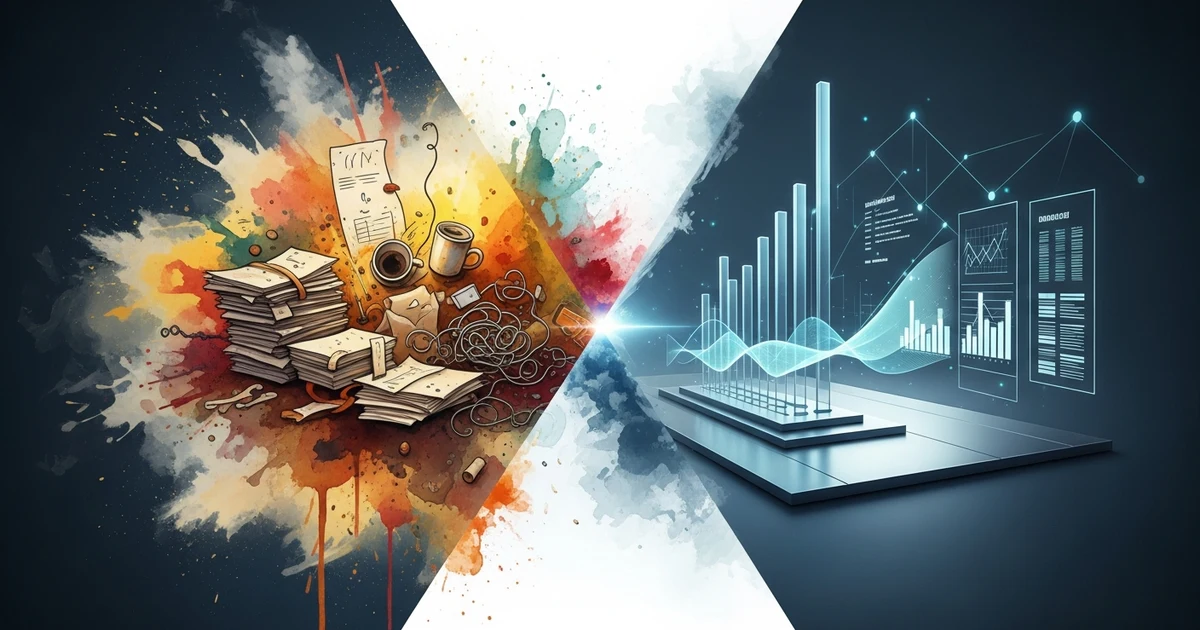
Most marketing agencies sell campaigns, charge monthly retainers, and require constant oversight. At BattleBridge, we've built autonomous AI marketing systems that operate with minimal manual intervention — our multi-agent platform currently manages several production systems across different industries.
The difference isn't just operational. While traditional agencies hire account managers to run campaigns, we deploy specialized AI agents that handle content creation, SEO optimization, and lead management. After 18+ years in traditional marketing, I founded BattleBridge because campaign-based services with constant human bottlenecks weren't delivering the scalability businesses need.
This represents a fundamental shift from service-based to system-based marketing. Our approach focuses on building marketing machines rather than delivering ongoing services.
Problems With Traditional Marketing Agency Models
Retainer Models Without Output Guarantees
Traditional agencies operate on retainer models that prioritize steady revenue over client results. You might pay $10,000-$50,000 monthly for a team that produces limited content, runs basic ad campaigns, and delivers monthly reports.
The economics often don't align with value. A $15,000 monthly retainer equals $180,000 annually. What do you receive? Access to junior account managers following standard procedures and senior strategists attending monthly calls.
BattleBridge's AI agents focus on consistent output rather than time-based billing. Our content systems have generated hundreds of articles across multiple client accounts. Our SEO systems create location-specific pages at scale. We charge for systems and results, not time and access.
Campaign Boundaries Limit Systematic Growth
Traditional marketing firms think in discrete campaigns with defined start and end dates. They launch initiatives, optimize during the campaign period, report results, then pitch the next project. This creates artificial boundaries that prevent integrated, systematic growth.
AI-powered marketing operates systematically. Our content agents don't run "blog campaigns" — they understand content strategy, identify ongoing opportunities, create brand-consistent content, and publish according to strategic schedules. The system operates continuously rather than in campaign cycles.
For example, when we implemented our SEO system for a senior living directory, it didn't execute a one-time project. The system generated location-specific content for communities across multiple states using programmatic SEO principles. The agent analyzes search patterns, creates relevant content, and maintains optimization across all pages simultaneously.
Human Dependencies Create Execution Delays
Agency workflows depend on human coordination and availability. Your project waits for the copywriter, who waits for the strategist, who waits for client approval. Team member vacations or departures can halt progress entirely.
AI systems operate continuously. Our content agents work around the clock, our CRM systems process leads immediately, and our SEO agents monitor rankings and update optimizations without requiring human scheduling or availability.
BattleBridge's Multi-Agent Approach
Specialized Agents Replace Department Functions
Rather than using basic AI tools or simple automation, we've developed specialized agent systems that handle distinct marketing functions:
- Content System: Research, writing, and publishing for blogs, landing pages, and marketing materials
- SEO System: Keyword research, on-page optimization, and technical SEO management
- CRM System: Lead scoring, contact management, and follow-up automation
- Research System: Market intelligence and competitive analysis
- Social System: Content creation and scheduling across platforms
- Email System: Campaign development and audience segmentation
- Analytics System: Performance tracking and insight generation
- PPC System: Paid campaign management and optimization
- Lead System: Prospect qualification and routing
- Project System: Task coordination between other systems
Each system accesses specialized capabilities tailored to its function. The Content System uses brand voice analysis, competitor gap identification, and content optimization capabilities. The SEO System uses keyword clustering, SERP analysis, and technical audit capabilities.
Production Systems With Measurable Outcomes
Our agents manage live systems for active businesses:
Senior Living Directory: Our SEO and Content systems built and maintain a directory covering thousands of communities across hundreds of cities. The system generates location-specific content, manages community profiles, and optimizes for local search terms.
CRM Platform: Our CRM system manages thousands of contacts with automated lead scoring, contact enrichment, and pipeline management. Unlike standard CRM tools, our system is custom-built and continuously optimized by AI.
Coaching Platform: Our Content and Social systems manage a coaching platform that delivers personalized content to different audience segments, creating course materials and email sequences tailored to user progress.
These represent live systems processing real traffic, managing actual leads, and generating measurable results.
Operational Advantages of AI Marketing Systems
Predictable Costs vs. Escalating Retainers
Traditional agencies require multiple specialists to deliver comprehensive marketing services. These team members cost $60,000-$120,000 annually each, plus benefits, training, and management overhead.
AI system deployment involves fixed development costs with predictable maintenance fees. Once built, an agent handles unlimited tasks without additional labor costs, vacation time, healthcare expenses, or turnover risk.
Traditional Agency Economics:
- $15,000/month retainer = $180,000/year
- Project fees: $20,000-$50,000 additional
- Ad spend management: 10-20% of media budget
- Total annual investment: $220,000-$280,000
AI System Economics:
- Fixed development and deployment costs
- Predictable maintenance fees
- No retainer escalation over time
- Typically 60-70% cost reduction compared to traditional agencies
Execution Speed Advantages
Traditional agencies move slowly due to human coordination requirements. Strategy meetings, approval processes, revision cycles, and quality checks create weeks of delay between decision and execution.
AI systems execute immediately:
- Product descriptions: Hours instead of weeks
- Landing page variations: Same-day deployment
- Competitive analyses: Overnight completion
This speed advantage compounds over time. While traditional agencies plan next quarter's initiatives, AI systems have already tested, optimized, and scaled multiple approaches.
Specialized Expertise Without Premium Costs
Traditional agencies hire generalists who understand multiple disciplines at a surface level. AI systems develop deep specialization in specific functions through continuous learning from every task completed.
Our SEO system has analyzed extensive page data, tested numerous optimization approaches, and learned from every deployment. It doesn't forget best practices or make inconsistent decisions across projects.
Our Content system has created thousands of pieces across various industries. It understands what resonates with different audiences, how to match brand voices consistently, and which formats drive engagement for specific goals.
This specialized expertise operates continuously without the premium pricing agencies charge for senior specialist time.
Technical Architecture of Autonomous Marketing
Distributed Processing for Optimal Performance
Our agent systems run across multiple dedicated servers to prevent performance bottlenecks:
Primary Content Server: Content creation, research, and planning systems CRM and Analytics Server: Lead processing, contact management, and performance tracking SEO and Optimization Server: Technical SEO, social media, and conversion optimization
This distributed approach ensures that when one system handles intensive tasks, other systems continue operating at full capacity.
Inter-Agent Coordination Replaces Project Management
Single AI tools require human coordination between tasks. Multi-agent systems coordinate automatically. Our Content system creates articles, notifies the SEO system to optimize them, triggers the Social system to create promotional content, and alerts the Analytics system to track performance.
This coordination happens automatically without project managers, status meetings, or manual coordination. Agents communicate directly and execute integrated marketing strategies with minimal oversight.
Continuous Learning Without Training Overhead
Traditional agencies improve through expensive training programs and strategic hires. Our systems improve through continuous learning from every completed task.
When our Content system creates high-engagement articles, it analyzes successful elements and applies insights to future content. When our SEO system identifies effective ranking factors, it incorporates that knowledge into optimization processes.
The Evolution Beyond Traditional Marketing Agencies
From Campaign Thinking to System Operations
The marketing industry is shifting from campaign-based thinking to system-based operations. Instead of predetermined workflows, businesses deploy intelligent systems that make decisions based on real-time data and changing conditions.
Our systems don't just execute marketing tasks — they identify opportunities, optimize strategies, and adapt to market changes. When our SEO system notices competitor content gaps, it evaluates opportunities, creates optimized content, and publishes strategically.
Preparing for AI-Powered Search Evolution
Traditional agencies optimize primarily for Google's current algorithm. Forward-thinking businesses prepare for AI-powered search engines and changing user behavior patterns.
Our SEO system optimizes for both traditional search engines and AI-powered results. It creates content that ranks in current search while also being suitable for citation by AI systems. This dual optimization provides competitive advantages as search behavior evolves.
Most traditional agencies haven't adapted to generative engine optimization principles. They're optimizing for historical search patterns while the industry moves toward AI-integrated results.
Market Forces Driving Industry Change
Within the next few years, traditional marketing agencies will need to adopt AI agent systems or face obsolescence due to economic pressures. The cost and speed advantages are becoming too significant to ignore.
Businesses won't pay $180,000 annually for work that AI systems can complete more effectively for significantly less. They won't accept multi-week delivery times when systems complete projects in hours. They won't tolerate inconsistent quality when systems deliver predictable results.
BattleBridge represents this industry evolution. We're not a traditional agency adding AI tools — we're an AI-first system that builds marketing infrastructure.
Implementation and Next Steps
Traditional marketing agencies will continue selling campaigns and charging retainers for work that AI systems can complete more effectively and efficiently.
BattleBridge builds marketing infrastructure that operates continuously. Our multi-agent systems and specialized capabilities demonstrate that autonomous marketing represents current reality rather than future possibility.
Explore Our Approach:
- Review our technical capabilities and system architecture
- Examine case studies of live system implementations
- Understand the economic advantages of system-based vs. service-based marketing
Ready to Explore System-Based Marketing?
Contact us to discuss how AI marketing systems can replace traditional agency relationships. Learn about building marketing infrastructure that scales without human limitations.
The choice is straightforward: continue paying agencies for work that systems can automate, or build infrastructure that scales systematically without traditional constraints.
Learn more about AI marketing systems in our complete implementation guide or explore autonomous content creation strategies.