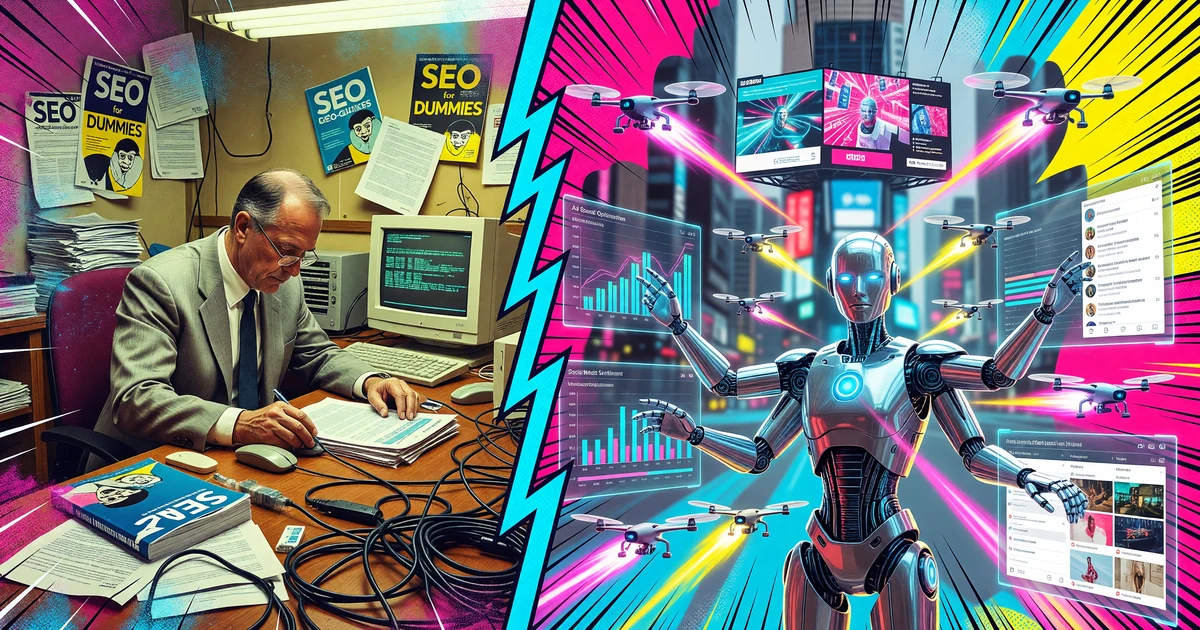
Full-service AI agencies deploy autonomous multi-agent systems that execute across all marketing channels simultaneously, while SEO-only agencies manually optimize single touchpoints using human specialists. The fundamental difference isn't just scope—it's architecture. Modern marketing requires coordination between channels that human teams struggle to maintain efficiently, while AI systems can execute integrated strategies without coordination overhead.
The traditional "SEO agency vs full-service agency" debate has evolved beyond simple scope differences. Today's question is whether isolated channel optimization can compete with integrated systems that optimize across all touchpoints simultaneously.
The Architecture Problem: Why Traditional Coordination Models Struggle
Human Coordination Creates Bottlenecks
Traditional full-service agencies often struggle because coordinating multiple specialists creates inefficiencies. Common challenges include:
- Large teams requiring extensive management oversight
- Regular alignment meetings that consume significant billable time
- Delays between departments implementing complementary strategies
- Duplicate research across teams working on the same client
These coordination challenges historically made focused SEO specialists more efficient than broader service offerings.
Multi-Agent Systems Enable Better Integration
AI-powered marketing systems can eliminate coordination friction through automated agent communication. When an SEO optimization reveals high-converting keywords, the system can automatically:
- Share performance data across all marketing channels
- Trigger complementary content creation
- Update audience segmentation based on search intent
- Adjust campaign messaging for consistency
This integration happens instantly rather than requiring human coordination cycles.
Service Model Comparison: Capabilities and Limitations
SEO-Only Agency Focus Areas
Typical SEO-Only Services:
- Keyword research and content optimization
- Technical SEO audits and implementation
- Link building and authority development
- Search-focused content strategy
- Ranking monitoring and reporting
Integrated Marketing System Capabilities
Cross-Channel Marketing Execution:
- Search optimization with broader funnel integration
- Paid search campaigns informed by organic data
- CRM systems that score leads based on search behavior
- Content strategies that work across multiple channels
- Email sequences triggered by search interactions
Execution Speed: Integrated vs Siloed Approaches
Case Study: USR Senior Living Directory Implementation
Our automated system deployment included:
- 977 city-specific pages with local optimization
- 51 state landing pages with geo-targeted content
- 4,757 community listings with structured data markup
- Integrated paid campaigns for commercial searches
- Lead nurturing workflows for organic traffic
Implementation timeline: 3 weeks
Traditional agency coordination typically requires:
- SEO content development: 6-8 weeks
- Paid campaign setup: 2-3 weeks (sequential)
- CRM workflow development: 3-4 weeks
- Cross-channel testing: 2-3 weeks
Traditional coordination timeline: 13-18 weeks
Note: Timeline differences based on our internal deployment tracking. Results may vary based on project scope and agency capabilities.
Cost Structure Analysis
| Service Model | Monthly Investment | Team Structure | Coordination Overhead | Typical Timeline |
|---|---|---|---|---|
| SEO-Only Specialists | $3,000-8,000 | 2-3 focused experts | Minimal internal | 3-6 months |
| Traditional Full-Service | $8,000-25,000 | 6-12 team members | 25-40% of time | 6-12 months |
| AI-Integrated Systems | $4,000-12,000 | Automated agents | Near zero | 1-3 months |
Revenue Impact: Single-Channel vs Multi-Channel Optimization
Attribution Gaps in SEO-Only Approaches
SEO specialists excel at organic optimization but may miss broader revenue opportunities:
Potential Blind Spots:
- High-intent keywords that convert better through paid search
- Email capture opportunities from organic visitors
- Social amplification of search-optimized content
- Lead nurturing for users in early research phases
Integration Example: For "senior living costs" keyword targeting, an integrated approach might include:
- Long-term SEO content for organic ranking
- Paid ads for immediate visibility on competitive terms
- Lead magnets like cost calculators for email capture
- Nurture sequences for price-sensitive prospects
- Social content to build topical authority
This comprehensive approach can generate significantly more qualified leads than SEO optimization alone.
Cross-Channel Attribution Benefits
Integrated systems provide clearer ROI measurement by tracking:
- Multi-touch attribution across paid and organic channels
- Long-term nurture impact on originally organic visitors
- Social amplification effects on search performance
- Cross-channel audience insights
When SEO-Only Agencies Make Sense
Established Businesses with Existing Marketing Infrastructure
SEO specialists can be effective when you already have:
- Strong paid advertising management
- Robust CRM and email marketing systems
- Active social media presence
- Clear attribution tracking across channels
In these cases, you need deep SEO expertise rather than broad coordination.
Technical SEO Projects
For specific technical challenges, SEO specialists often provide:
- Site migration expertise
- Complex technical audit capabilities
- Industry-specific SEO knowledge
- Deep search algorithm understanding
Budget-Constrained Situations
Businesses with limited marketing budgets may benefit from focused SEO investment, especially when:
- Organic search is the primary acquisition channel
- Timeline for results can extend 6-12 months
- Other marketing channels aren't viable yet
The Integration Advantage: How Modern Systems Create Compound Growth
Cross-Channel Data Utilization
Integrated marketing systems leverage data across channels more effectively. Search behavior informs paid targeting, while paid campaign data guides SEO content priorities. This creates feedback loops that improve all channels simultaneously.
Content Multiplication Effects
Single content assets can serve multiple purposes:
- SEO articles become social media content series
- Paid ad performance data enhances organic meta descriptions
- Email engagement metrics inform search intent understanding
- Social interactions predict trending search topics
Rapid Testing and Iteration
Integrated systems can test market demand quickly:
- Deploy paid campaigns for immediate market feedback
- Create SEO content based on paid campaign insights
- Launch social amplification for proven topics
- Build nurture sequences for validated audiences
Making the Right Choice for Your Business
Evaluate Your Current Marketing Maturity
Consider Full-Service AI Integration If:
- You need coordination across multiple channels
- Speed to market is important
- You want comprehensive attribution tracking
- Growth is the primary objective
- Annual revenue exceeds $500K
SEO-Only May Work If:
- You have other marketing channels well-covered
- You need specific technical SEO expertise
- Budget requires focused investment
- Timeline allows for 6-12 month organic growth cycles
Key Questions for Agency Evaluation
For Full-Service Providers:
- How do you coordinate between different marketing channels?
- Can you show examples of cross-channel attribution?
- What's your typical deployment timeline?
- How do you prevent channel conflicts?
For SEO Specialists:
- How do you integrate with existing marketing efforts?
- What happens when you identify non-SEO opportunities?
- How do you measure business impact beyond rankings?
The Future of Marketing Coordination
Technology Eliminates Traditional Trade-offs
Historically, businesses chose between deep expertise and broad coordination. AI systems can provide both:
- Specialized knowledge in each marketing discipline
- Perfect coordination between all channels
- Instant scaling without hiring constraints
- Continuous improvement across all clients
Customer Journey Complexity Demands Integration
Modern buyers interact with brands across multiple touchpoints. Single-channel optimization ignores customer reality and misses revenue opportunities.
Competitive Advantages Through Integration
Businesses using integrated systems will likely outperform those using isolated specialists. When competitors can optimize across all channels simultaneously, single-channel approaches may become less competitive.
The BattleBridge Approach: Autonomous Marketing Systems
Our autonomous AI agents eliminate traditional coordination problems by providing:
- Specialized expertise in each marketing domain
- Automated coordination between all agents
- Scalable deployment without human bottlenecks
- Continuous learning from cross-client data
Rather than choosing between breadth and depth, our system provides both through automated specialization and coordination.
The question isn't whether you need SEO expertise—you do. The question is whether isolated SEO optimization can compete with integrated systems that coordinate search strategy with all other marketing channels.
We've deployed this approach across multiple client projects, generating measurable results through automated coordination rather than human management overhead.
Want to explore integrated marketing automation for your business? Learn about our approach or discuss your specific requirements with our team.
Travis Phipps is the founder of BattleBridge, an AI-first marketing agency. With 18+ years of marketing experience, he focuses on building automated systems that coordinate marketing activities more efficiently than traditional agency models.