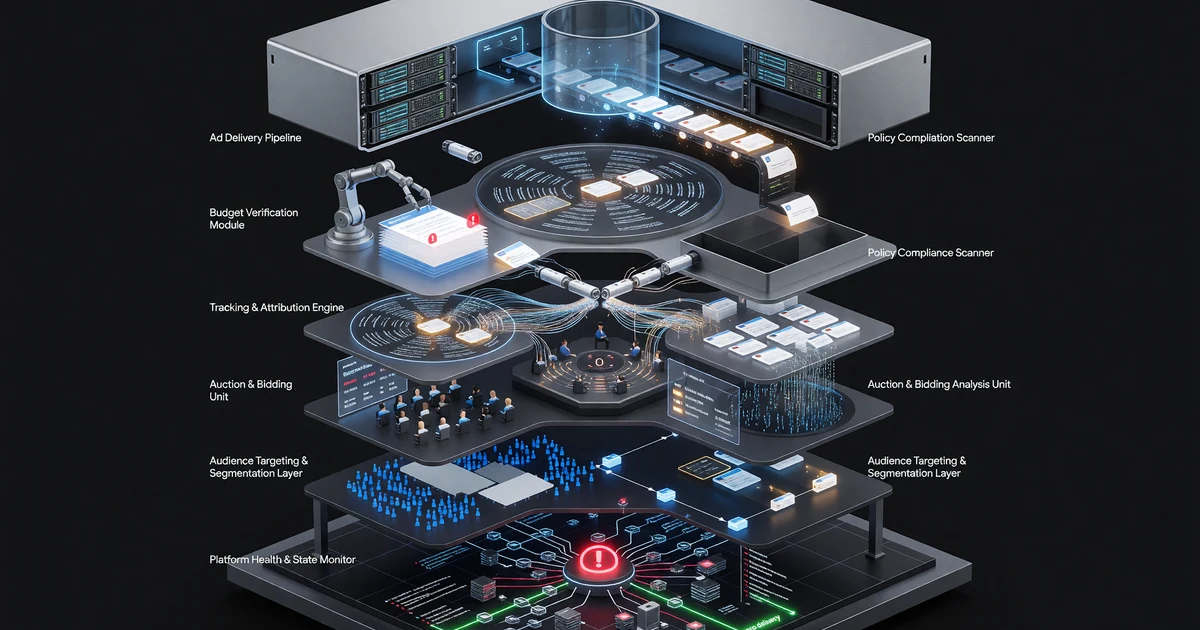
When ad delivery drops to zero, AI diagnoses the problem by checking the entire delivery chain at once: billing, budgets, policy status, campaign settings, audience eligibility, bids, tracking, landing pages, feeds, and recent edits. The fastest path is not guessing; it is narrowing the failure layer until the system can say, "This campaign stopped entering auctions because of X."
That is the difference between a media buyer clicking through dashboards for 45 minutes and a production AI agent returning a ranked diagnosis in minutes.
At BattleBridge, we do not treat advertising as a weekly optimization task. We treat it like infrastructure. Our agency runs 10 deployed AI agents across 3 servers, with 46 registered skills, and we use that operating model across real systems: a senior living directory with 977 city pages across 51 states and 4,757 community listings, a CRM with 8,442 contacts, and the EBL coaching platform.
A zero-delivery event is exactly the kind of problem that exposes the gap between a traditional campaign team and an AI-first marketing machine.
Why Ads Suddenly Stop Delivering
Most delivery failures are not mysterious. They are usually caused by one blocked layer in the ad system.
The problem is that ad platforms spread the evidence across too many screens: campaign status, ad group status, ad approval, payment status, budget pacing, bid strategy, conversion diagnostics, audience manager, landing page checks, product feeds, account notifications, and sometimes API-only fields.
A human can find the issue. The question is how much time gets burned before they do.
The Delivery Chain Has More Failure Points Than Teams Admit
For a campaign to spend, all of these must be true:
- The account must be billable.
- The campaign must be active.
- The ad group or ad set must be active.
- The ad must be approved or eligible.
- The budget must be available.
- The bid must be competitive enough to enter auctions.
- The audience must be large enough.
- The landing page must be reachable and compliant.
- Tracking must not block optimization.
- The platform must have enough eligible inventory.
- Recent edits must not have reset or constrained delivery.
If one layer fails, spend can go to zero.
That is why an ad delivery drop should be diagnosed like a production incident, not discussed casually in a weekly status meeting.
The Usual Causes
The most common causes of zero delivery include:
- Daily or lifetime budget exhausted earlier than expected.
- Payment failed or billing threshold hit.
- Campaign, ad set, keyword, creative, or product group paused.
- Ads disapproved after a policy scan.
- Landing page rejected, redirected, slow, or unavailable.
- Audience became too small because of exclusions or geography.
- Bid cap, cost cap, or ROAS target too restrictive.
- Conversion event missing after a site or tag change.
- Product feed rejected or out of stock.
- Campaign moved back into learning after structural edits.
- Keyword status changed because of low search volume.
- Platform outage or reporting delay.
Offline channels have their own version of this problem. In door drop advertising, delivery can fail because routes, quantities, dates, print approval, or distribution windows break. Digital ads have more telemetry, but the operating principle is the same: delivery is a chain, and the weakest link determines whether the message reaches the market.
How AI Diagnoses Zero Delivery in Minutes
A good AI ads agent does not "look at the dashboard." It runs a structured incident workflow.
That workflow should pull from the platform API, tracking system, CRM, landing page monitor, recent deployment history, feed status, and account configuration. Then it should produce a ranked list of likely causes with evidence.
This is the model behind Ads Arsenal -- AI-Agent Ads Management: productized agents that watch, diagnose, and act across the ad system instead of waiting for a person to notice a flat line.
Step 1: Confirm the Drop Is Real
The first step is separating a real delivery issue from a reporting delay.
An agent checks:
- Spend by 5-minute, 15-minute, and hourly windows.
- Impressions, clicks, conversions, and reach.
- Platform reporting freshness.
- API timestamp lag.
- Historical pacing for the same day and hour.
- Whether only one campaign dropped or the whole account dropped.
If spend is zero but impressions are still coming through, the problem may be attribution or cost reporting. If impressions are zero too, the campaign likely stopped entering auctions.
That distinction matters. Fixing tracking when the auction layer is blocked wastes time. Raising bids when the issue is billing also wastes time.
Step 2: Check Account-Level Blocks
Account-level failures are the fastest to rule in or out.
The agent checks billing status, account suspension notices, payment errors, identity verification, business verification, account spend limits, and platform-wide alerts.
If every campaign stopped at the same time, the cause is usually account-level, tracking-level, or platform-level. If one campaign stopped while others continued, the agent shifts into campaign-level diagnostics.
This is where AI has a practical advantage: it can compare all active campaigns instantly. A person often opens the campaign with the biggest problem first and misses the account-wide pattern.
Step 3: Inspect Campaign and Asset Eligibility
Next, the agent checks the objects that determine whether ads can enter auctions:
- Campaign status.
- Ad group or ad set status.
- Ad status.
- Keyword status.
- Creative approval.
- Landing page approval.
- Product feed status.
- Audience match status.
- Geo and device restrictions.
- Schedule windows.
A zero-spend problem often comes from a small edit that looked harmless: narrowing geography, adding an exclusion list, changing a bid cap, editing destination URLs, replacing creative, or applying a rule that paused low performers too aggressively.
The agent should not just report current status. It should compare current status against recent state.
"Ad disapproved" is useful. "Ad was approved until 10:14 AM, then disapproved after the final URL changed" is the diagnosis.
Step 4: Compare Recent Changes Against Delivery Timing
This is the part most dashboards do poorly.
If delivery stopped at 2:20 PM, the agent looks backward from that timestamp and asks what changed before the failure.
Examples of useful comparisons:
- Campaign budget changed at 2:07 PM.
- Bid strategy changed at 2:11 PM.
- Landing page deployment completed at 2:13 PM.
- Conversion tag stopped firing at 2:16 PM.
- Audience sync completed with 0 matched users at 2:18 PM.
- Feed upload rejected 4,757 rows at 2:19 PM.
Those correlations are not proof by themselves, but they shrink the search space fast.
This is why BattleBridge builds marketing systems as connected infrastructure. Our Architecture of an Agentic Marketing System explains the broader operating model: agents are more useful when they can inspect multiple parts of the machine, not just one vendor dashboard.
What a Production Diagnosis Looks Like
A useful diagnosis should be short, evidence-based, and actionable.
Not:
"Delivery appears limited. Please check campaign settings."
That is dashboard filler.
A better output looks like this:
"Campaign Senior Living - TX Cities stopped spending at 09:35. Account billing is active. Other campaigns are spending. The affected campaign has 0 eligible ad groups because the new exclusion audience applied at 09:28 reduced estimated reach below the platform minimum. Remove the exclusion or split the campaign by metro. Expected recovery: delivery should resume within 15-30 minutes after eligibility refresh."
That is operationally useful.
The Diagnosis Needs Ranked Causes
AI should not pretend every signal is equally important. It should rank causes by likelihood and impact.
A proper incident report includes:
- Primary suspected cause.
- Supporting evidence.
- Conflicting evidence.
- A recommended fix.
- Expected recovery window.
- Verification check.
- Escalation path if delivery does not recover.
For example:
- Cause: bid cap too low.
- Evidence: campaign active, ads approved, billing active, audience eligible, but auction insights show low participation after target CPA changed from $85 to $22.
- Fix: restore previous bid constraint or loosen target CPA incrementally.
- Verification: impressions should return within the next auction window.
That is how you turn AI into an operator, not a chatbot.
The Agent Should Know the Business Context
A campaign diagnostic agent is better when it understands what the business is trying to do.
BattleBridge systems are not built around generic dashboards. They connect advertising to business assets. In USR, that means a directory with 977 cities, 51 states, and 4,757 communities. In our CRM, it means 8,442 contacts with real segmentation and follow-up logic. In EBL, it means a coaching platform where lead quality and lifecycle stage matter more than raw click volume.
That context changes how an agent responds.
If a campaign for senior living communities in Florida stops spending, the agent should know whether that campaign feeds a city page cluster, a CRM segment, a call workflow, or a revenue-critical geography. A $200 missed spend window on a test campaign is not the same as a zero-delivery event on a production acquisition system.
Why Traditional Agencies Miss These Problems
Traditional agencies are built around human cycles: launch, monitor, optimize, report.
That model breaks when the system needs continuous diagnosis.
A media buyer may check spend at 9 AM, 1 PM, and 4 PM. If a campaign stops at 10:12 AM, the account may lose most of a business day before anyone notices. If the issue happens Friday evening, it can sit all weekend.
That is not a talent problem. It is an operating model problem.
BattleBridge is not a traditional agency. We build marketing machines, not run campaigns. The difference is not branding; it changes the architecture.
Human Teams Are Good at Judgment, Bad at Constant Watching
Humans should decide strategy, positioning, offer structure, budget allocation, and risk tolerance.
Humans should not manually refresh dashboards to check whether spend went to zero.
That is machine work.
An AI agent can watch delivery continuously, compare live performance against expected pacing, inspect platform status, and alert with evidence. It does not get distracted. It does not wait for a reporting meeting. It does not forget to check the feed after a site deployment.
The best setup combines both:
- Agents monitor and diagnose continuously.
- Humans approve higher-risk changes.
- Agents execute low-risk fixes within predefined rules.
- Humans review the system-level pattern weekly.
That is a better use of senior marketing talent.
Productized Agents Beat Ad Hoc Troubleshooting
Ad hoc troubleshooting depends on who is available, what they remember, and how well the account is documented.
Productized agents follow the same diagnostic path every time.
That consistency matters. If your delivery issue is caused by billing, the agent should catch it. If it is caused by a rejected landing page, it should catch that too. If it is caused by a bid cap, a broken feed, or a bad audience sync, the workflow should still hold.
That is the same philosophy behind Multi-Agent Marketing Systems. One AI prompt is not enough for production marketing. You need specialized agents with access, memory, skills, and clear responsibility.
The BattleBridge Standard for Ads Monitoring
For us, an ad system is not healthy because it has a nice dashboard. It is healthy when it can detect failure, diagnose cause, and recover quickly.
The minimum standard includes:
- Spend pacing monitored throughout the day.
- Impression and click anomalies checked against expected ranges.
- Account-level blocks detected automatically.
- Policy and approval changes watched.
- Landing pages tested.
- Tracking events validated.
- CRM ingestion monitored.
- Recent edits compared against performance changes.
- Alerts written in plain language with evidence.
- Fixes logged for review.
This is the practical reason to use autonomous agents in marketing. Not because AI is fashionable. Because marketing systems now have too many moving parts for manual oversight to be reliable.
An ad delivery drop is a small incident when it is caught in 5 minutes. It becomes a revenue problem when it is found tomorrow.
FAQ
Why did my ads stop spending?
Ads usually stop spending because of budget caps, billing problems, policy disapprovals, broken tracking, narrow audiences, low bids, paused assets, or platform learning resets. An ad delivery drop is rarely random; it usually has a specific account, campaign, or data-layer cause.
How do you fix zero ad delivery?
Start by identifying whether the blockage is financial, policy-related, technical, targeting-related, or auction-related. Then fix the constraint, verify delivery eligibility, and monitor spend recovery in short intervals instead of waiting for a daily report.
Can AI diagnose a delivery drop?
Yes. AI can diagnose an ad delivery drop by comparing live platform status, recent edits, tracking events, audience sizes, budget pacing, approval state, and CRM signals faster than a human checking each screen manually.
What causes ads to stop delivering?
Common causes include exhausted budgets, failed payments, disapproved ads, rejected landing pages, tracking outages, audience exclusions, bid limits, inventory constraints, paused campaigns, and broken feeds. The right fix depends on which layer stopped the system from entering the auction.
How fast can a delivery problem be caught?
A properly instrumented AI agent can catch zero delivery within minutes of spend, impression, or conversion events falling outside expected ranges. The key is monitoring the live system continuously, not reviewing yesterday's dashboard after the budget is already missed.
Build the Machine Before the Next Failure
If your ads stop spending, the immediate goal is to restore delivery. The bigger goal is to make sure the same failure is caught faster next time.
BattleBridge builds autonomous marketing systems that monitor, diagnose, and operate across advertising, SEO, CRM, content, and business data. Start with BattleBridge Home, review Ads Arsenal -- AI-Agent Ads Management, or go deeper into the PPC Guide if you want the operating model behind better paid media.
Get Your Free Ad Delivery Drop Audit
BattleBridge runs autonomous AI agents that handle this end to end — research, content, distribution, and reporting — for a flat monthly rate instead of an agency retainer. We'll audit your current setup, show you exactly where agents outperform your existing stack, and hand you the findings whether you hire us or not.
Get your free audit — 30 minutes, no pitch deck, real numbers.