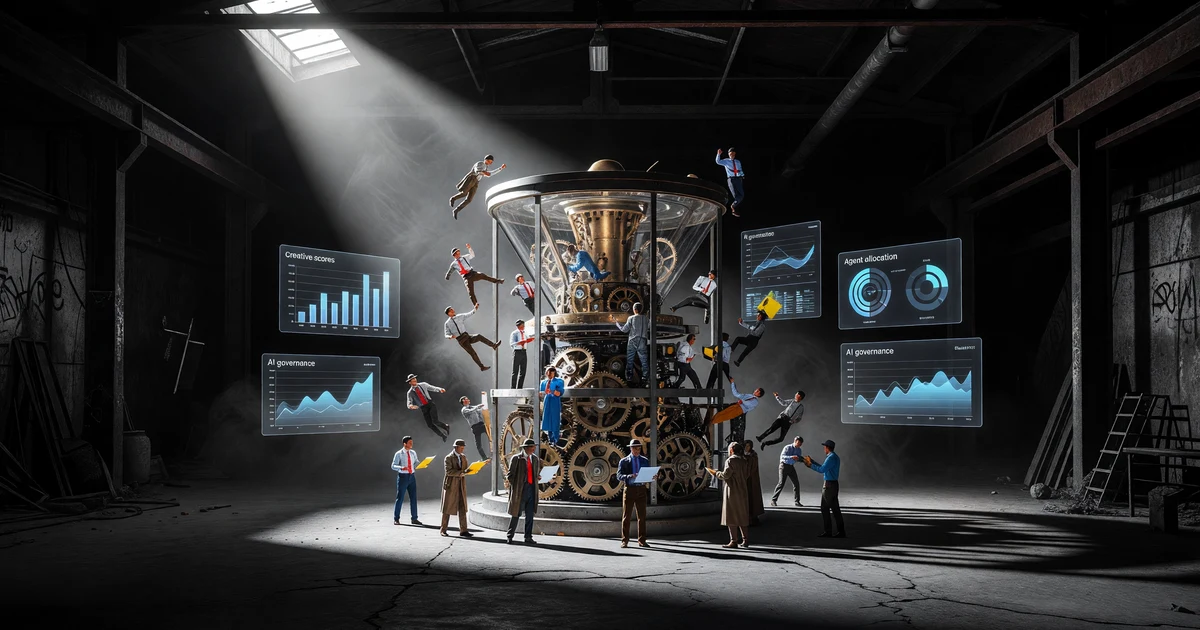
Scaling from 150 creatives to a self-managing hopper means moving creative operations out of spreadsheets and into a system that can classify, score, rotate, retire, and refresh assets without waiting on a human traffic manager. The core idea is simple: once creative volume gets large enough, the bottleneck is no longer making more ads; it is knowing which ads deserve attention, budget, variants, or burial.
That is the scaling story behind this build. BattleBridge does not operate like a traditional agency that makes campaigns, checks reports, and schedules another batch of concepts two weeks later. We build marketing machines. In this case, the machine was a creative hopper designed to keep 150 assets organized, accountable, and ready for autonomous decision-making.
BattleBridge already runs 10 deployed AI agents across 3 servers, with 46 registered skills powering production work across SEO, CRM, content, research, and advertising operations. Those agents support real systems: USR, a senior living directory with 977 city pages across 51 states and 4,757 community listings; a CRM with 8,442 contacts; and the EBL coaching platform. The same operating logic behind those systems applies to creative scale: structure first, automation second, judgment encoded into repeatable workflows.
The Problem: 150 Creatives Is Not a Library, It Is a Traffic System
A folder with 150 ad creatives is not an asset library. It is an ungoverned traffic system.
At small volume, people can manage creative by memory. They know which video performed well, which static image got rejected, which headline belongs to which offer, and which concept is just a derivative of something that already failed. That breaks quickly.
By the time an account has 150 assets, several problems appear at once:
- Naming conventions stop being reliable.
- Creative fatigue becomes harder to spot.
- Winning concepts get buried under newer uploads.
- Similar assets compete against each other.
- Budget spreads across too many mediocre variants.
- Reporting tells you what happened, but not what to do next.
- New creative gets produced without learning from old creative.
That is where many ad accounts start to look busy while getting less intelligent.
The mistake is assuming the next step is “more creative.” Sometimes it is. But volume without routing creates noise. The more important question is: what system decides where each creative goes next?
For BattleBridge, the answer was a hopper.
What We Mean by a Hopper
A hopper is not just a holding tank for ads. It is a staged operating system for creative inventory.
Each creative enters the hopper with enough metadata to be useful: offer, audience, angle, format, platform, funnel stage, production source, status, and performance state. From there, the system can determine whether the asset should be tested, scaled, paused, refreshed, converted into variants, or archived.
The hopper matters because it gives agents something structured to reason over. AI is weak when it is asked to “look at these files and tell me what is good.” It becomes much stronger when each creative asset has clean fields, consistent labels, and explicit next-action rules.
That is the difference between using AI as a clever assistant and building an agentic marketing system.
If you want the broader architecture behind this approach, start with Architecture of an Agentic Marketing System. The same principles used to coordinate 10 agents across production servers apply directly to creative operations.
The Build: Turning Creative Chaos Into Operating States
The first move was not automation. It was classification.
Before the hopper could manage creative, every asset needed to belong to an operating state. We used six practical states:
1. Intake
Intake is where new creative enters the system.
At this stage, the asset is not assumed to be ready for spend. It needs basic classification: format, hook, offer, audience, claim type, compliance sensitivity, destination, and campaign fit.
This is where most teams under-document. They upload creative into the ad platform and trust the platform to sort it out. That creates downstream problems because platform data is not the same as operational memory. Meta or Google can tell you performance. They cannot tell you why a concept exists, what strategic angle it represents, or whether it is a variant of a previous winner.
2. Test Queue
The test queue is where eligible assets wait for controlled exposure.
The purpose is not to give every creative equal spend. The purpose is to give each asset enough signal to make a decision. That requires rules around budget, audience, duration, and comparison groups.
A hopper becomes useful when it can distinguish between “not tested,” “tested without enough data,” and “tested with enough data to judge.” Those are different states. Treating them the same creates bad decisions.
3. Active Rotation
Active rotation is where assets earn real exposure.
This state includes creatives that have passed basic testing and are eligible for budget. The hopper monitors their performance against account-specific thresholds: click-through rate, cost per lead, conversion rate, thumb-stop rate, hold rate, or whatever metrics matter for the channel and objective.
The point is not to worship a single metric. The point is to know what role the creative is supposed to play. A top-of-funnel video and a retargeting static image should not be judged by the same standard.
4. Scale Candidates
Scale candidates are assets that deserve more attention.
These are not just winners. They are assets that explain something useful: a hook that works, an audience that responds, a visual pattern that creates stopping power, or an offer frame that reduces friction.
This is where creative scaling becomes compounding. A single winning asset can become five structured variants if the system knows what made it work.
5. Fatigue Watch
Fatigue watch catches assets before they become expensive problems.
A creative does not go from “winner” to “dead” in one clean step. It drifts. Frequency climbs. CTR softens. Conversion quality changes. Spend efficiency gets less stable. Comments shift. The same asset that carried last month’s results can become a drag if nobody is watching its decay curve.
The hopper flags fatigue candidates so the system can rotate alternatives, produce variants, or reduce exposure before performance collapses.
6. Retired or Archived
Retirement is not failure. It is inventory hygiene.
Some assets should never be tested again. Some should be saved because the angle worked but the execution did not. Some should become source material for future variants. The hopper needs to know the difference.
A retired asset with clear notes is still valuable. A forgotten asset in a folder is not.
The Agent Layer: Making the Hopper Self-Managing
The hopper became self-managing when we connected structured creative states to agent actions.
BattleBridge has 46 registered skills across its AI system. That matters because a useful marketing agent cannot only “write copy” or “summarize data.” It needs skills that map to work: classification, scoring, content generation, research, QA, enrichment, publishing, and reporting.
The creative hopper used that same model.
Classification Agent
The classification agent reads each creative record and normalizes it into the system.
It identifies format, concept family, hook type, audience, funnel stage, offer, and production status. That lets the hopper compare like with like. Without classification, a 150-asset library is just a pile of filenames and platform IDs.
This is also where the system starts building institutional memory. If ten assets use the same fear-based hook and all underperform, the next planning cycle should know that. If testimonial-style videos outperform polished brand assets, that should change production priorities.
Scoring Agent
The scoring agent converts performance data into next-action recommendations.
It does not just rank creative from best to worst. That is too crude. It scores by role and state. A new asset in the test queue needs a different scoring model than an active asset with 30 days of spend history.
The output is operational:
- Promote to active rotation.
- Keep testing until minimum signal is reached.
- Move to fatigue watch.
- Generate variants.
- Pause.
- Archive.
- Flag for human review.
That last state matters. Autonomous systems should not pretend every decision is equally clear. Good automation knows when uncertainty is high.
Variant Agent
The variant agent turns winners into structured follow-up assets.
If a hook works, it can create new copy angles. If a visual format works, it can brief new production. If an offer frame converts, it can be adapted by audience segment or funnel stage.
This is where the hopper starts behaving like a creative engine instead of a database. It does not wait for a monthly brainstorm. It continuously extracts what worked and feeds the next production cycle.
That is also why we connect this work to Ads Arsenal — AI-Agent Ads Management. The goal is not to bolt AI onto ad accounts after strategy is done. The goal is to let agents participate in the operating loop itself.
QA and Governance Agent
The QA layer keeps speed from turning into slop.
It checks for missing metadata, duplicate concepts, unsupported claims, broken destination mapping, inconsistent naming, and assets that are stuck in the wrong state. This matters more as creative count increases. At 20 assets, a human can catch most issues. At 150, manual QA becomes a recurring tax.
Governance is not bureaucracy. It is what allows the system to move faster without losing track of reality.
The Scaling Lesson: More Creative Only Works With More Memory
This is the main lesson from the build: creative scale is not about output. It is about memory.
Most ad operations lose memory constantly. A contractor tests a batch of creatives. A strategist writes notes in a doc. A media buyer pauses a losing asset. A founder remembers one hook that worked three months ago. None of that becomes durable system knowledge unless it is captured in a structured way.
The hopper solved for that.
It preserved:
- Which concepts were tested.
- Which variants belonged to which parent idea.
- Which audiences saw which angles.
- Which assets failed because of weak creative versus weak distribution.
- Which winners deserved variants.
- Which assets were fatigued but not conceptually dead.
- Which creative themes should be avoided.
This is the same reason our programmatic SEO work for USR was built as a system instead of a one-time publishing project. Generating 977 city pages across 51 states only works when every page has structure, rules, and QA. The same principle applies to creative. You can read that build in Programmatic SEO at Scale and the deeper USR Case Study.
The channel changes. The operating truth does not.
Why Traditional Agency Workflows Break Here
Traditional agencies are built around campaigns.
Campaigns have briefs, timelines, deliverables, revisions, launches, reports, and recaps. That model works when the unit of work is a discrete campaign cycle. It struggles when the unit of work is a continuously learning machine.
A 150-creative system does not need another status meeting. It needs state management.
It needs to know what has signal, what lacks signal, what has decayed, what has been over-tested, what has been under-tested, and what should be produced next. Those decisions happen too often for a manual workflow to stay clean.
This is the divide between a traditional marketing agency and an AI-first operating model. We explain that difference directly in AI vs Traditional Marketing Agency, but the short version is this: agencies manage work; systems manage loops.
BattleBridge builds loops.
The Result: A Creative System That Improves While It Runs
The end state was not a prettier dashboard. It was a hopper that could manage creative movement with less human intervention and more consistency.
The system could:
- Ingest new assets with structured metadata.
- Separate untested assets from active assets.
- Identify assets with enough signal to judge.
- Promote strong performers into rotation.
- Flag fatigue before it became obvious in blended account performance.
- Recommend variants from proven concepts.
- Archive assets without losing historical learning.
- Keep production tied to performance evidence.
That is what makes this a useful creative scaling case study: the win was not that we had 150 creatives. The win was that the 150 creatives stopped behaving like clutter.
The system turned creative into governed inventory.
For a founder, that changes the work. You stop asking, “What did the agency make this week?” and start asking, “What did the machine learn, what did it move, and what should it produce next?”
That is the BattleBridge thesis in one sentence. We are not here to run campaigns forever. We are here to build marketing infrastructure that keeps improving.
If you want the full agency-level view, start at BattleBridge Home. If you are evaluating the business behind this infrastructure, read Invest in BattleBridge.
FAQ
How do you manage 150 ad creatives at once?
You manage 150 ad creatives by treating them as inventory, not files. Each asset needs metadata, performance history, lifecycle status, and clear rules for testing, scaling, retirement, and refresh.
What happens when an account has too many creatives?
When an account has too many creatives, performance signals get harder to read and weak assets can hide inside the mix. The fix is not fewer ideas; it is a better hopper that prioritizes what earns spend and pauses what does not.
How does a hopper organize creative at scale?
A hopper organizes creative at scale by grouping assets by offer, audience, angle, format, funnel stage, and performance state. The best systems also track what should be tested next, what should be recycled, and what should be permanently retired.
Can AI manage a huge creative library?
Yes, AI can manage a huge creative library when it has structured inputs, defined decision rules, and access to performance data. In a creative scaling case study, the AI should prove that it can reduce manual review while improving the speed and consistency of decisions.
How do you keep large creative sets fresh?
Large creative sets stay fresh when the system continuously identifies fatigue, pulls winners into variant production, and replaces stale assets before performance collapses. A creative scaling case study should show both the creative output and the refresh loop behind it.
Build the Hopper Before You Buy More Creative
If your ad account has dozens or hundreds of creatives, the next breakthrough may not come from another batch of assets. It may come from finally giving those assets a system.
BattleBridge builds AI-first marketing machines: agentic SEO systems, autonomous ad operations, CRM infrastructure, and creative workflows that keep learning after launch. If you want a marketing system that manages the loop instead of another vendor managing tasks, start with Ads Arsenal — AI-Agent Ads Management or talk to BattleBridge about building the machine behind your growth.
Get Your Free Creative Scaling Case Study Audit
BattleBridge runs autonomous AI agents that handle this end to end — research, content, distribution, and reporting — for a flat monthly rate instead of an agency retainer. We'll audit your current setup, show you exactly where agents outperform your existing stack, and hand you the findings whether you hire us or not.
Get your free audit — 30 minutes, no pitch deck, real numbers.