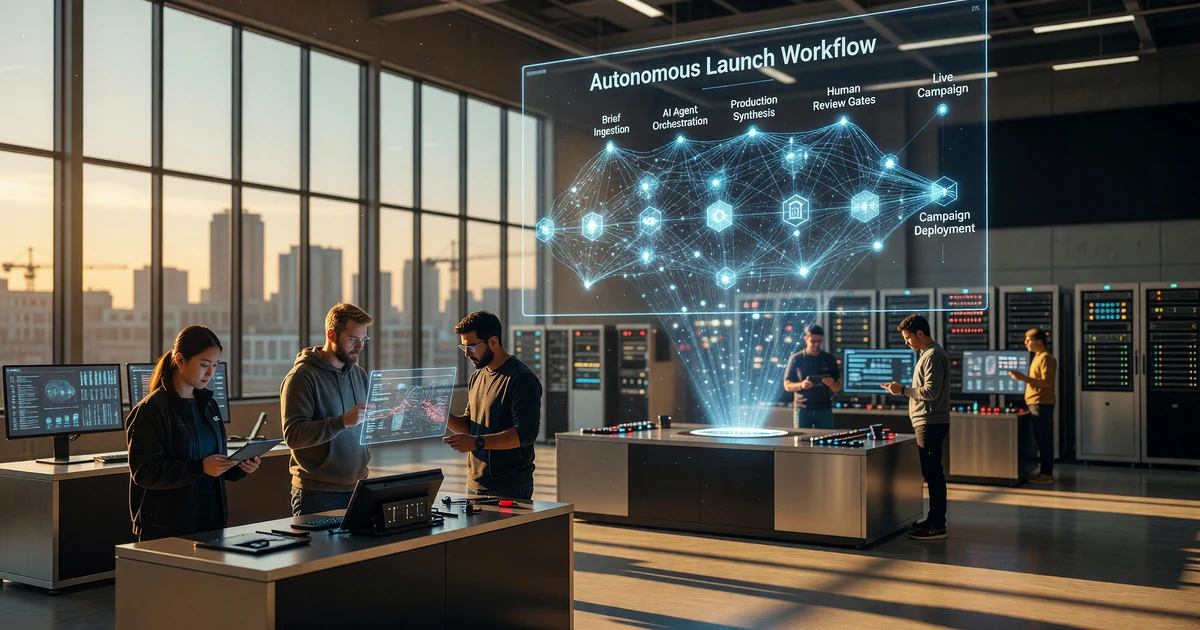
An autonomous campaign launch turns a marketing brief into live campaign infrastructure: strategy, copy, creative direction, landing pages, tracking, audience logic, QA, and reporting. The core concept is simple: instead of handing work from strategist to copywriter to media buyer to analyst, specialized AI agents break the brief into jobs, complete them in parallel, and route the final launch package through review.
At BattleBridge, this is not a demo workflow. We run 10 deployed AI agents across 3 servers with 46 registered skills, connected to real production systems: USR, a senior living directory with 977 cities, 51 states, and 4,757 communities; a CRM with 8,442 contacts; and the EBL coaching platform. The point is not to make campaigns cheaper by replacing humans with prompts. The point is to build marketing machines that launch, measure, and improve faster than a traditional agency operating through meetings, handoffs, and disconnected tools.
What Changes When Agents Own the Launch Workflow
Traditional campaign launches are slow because the work is fragmented. A strategist writes a brief. A copywriter interprets it. A designer waits for copy. A developer builds the page. A media buyer creates campaigns. An analyst checks tracking after the fact. Each handoff adds delay and risk.
Agentic marketing changes the operating model. The system does not wait for departments to pass work downstream. It decomposes the launch into structured tasks, assigns those tasks to specialized agents, and checks outputs against known constraints.
That is the practical difference between automation and autonomy. Automation repeats a predefined step. Autonomy decides the next step inside a governed system.
BattleBridge is built around that idea. We are not a traditional agency that runs isolated campaigns. We build marketing systems that can keep working after the initial launch. The system should know the offer, understand the audience, create assets, deploy pages, connect data, inspect performance, and identify the next action.
For the full model behind this, see What Is Agentic Marketing?. The launch workflow described here is one applied version of that architecture.
The Brief Becomes a Task Graph
A useful brief is not a document. It is raw material for a task graph.
When a brief enters the system, agents extract the operational requirements:
- Offer: what is being sold, promised, or promoted
- Audience: who the campaign is for
- Market: geography, vertical, or segment
- Conversion event: lead, booked call, sale, signup, download, intake form
- Budget range: spend level and risk tolerance
- Constraints: compliance, claims, brand language, exclusions
- Assets: existing pages, CRM records, creative, testimonials, proof points
- Deadline: target launch date and review windows
From there, the system can assign work. A research agent validates the market. A content agent drafts landing page sections. A media agent prepares campaign structure. A tracking agent defines conversion events and UTMs. A QA agent checks for missing requirements before launch.
This matters because most campaign failures are not caused by bad ideas. They are caused by gaps between the brief and execution: wrong audience, weak offer translation, missing tracking, unclear CTA, inconsistent messaging, or a landing page that does not match the ad.
An autonomous workflow attacks those gaps directly.
The BattleBridge Launch Stack
BattleBridge currently runs 10 AI agents across 3 servers with 46 registered skills. That matters because serious agentic systems are not one chatbot with a long prompt. They are distributed systems with specialized responsibilities, persistent memory, tool access, and review gates.
The same foundation powers real properties and platforms. USR is not a sample dataset. It is a senior living directory covering 977 cities, 51 states, and 4,757 communities. Our CRM is not a spreadsheet exercise. It contains 8,442 contacts. EBL is a real coaching platform, not a landing page mockup.
Those systems give the agents something most agencies do not have: operational context.
Production Data Beats Blank-Slate Brainstorming
A normal agency often starts with discovery calls and competitor tabs. That work still has value, but it is slow and shallow compared with agents operating against live systems.
For example, if the campaign involves senior living, the system can reason from USR’s production structure: city coverage, state coverage, community records, directory pages, and existing search patterns. That is different from asking a strategist to “come up with angles” from a blank page.
The same applies to CRM work. A campaign tied to 8,442 contacts can be segmented by lifecycle stage, geography, source, or engagement history. The launch does not need to guess who should receive which message. It can build from known data.
This is why we describe BattleBridge as an AI-first marketing agency, not an AI-assisted agency. The agents are not decorative. They sit inside the operating system.
The architecture behind that system is covered in Architecture of an Agentic Marketing System.
Skills Make the System Useful
Agents are only valuable if they can do specific work. That is where skills matter.
BattleBridge has 46 registered skills. A skill is a repeatable capability the system can call when needed: content generation, SEO mapping, campaign structuring, QA, research, CRM enrichment, landing page drafting, reporting, and related execution work.
Without skills, an AI agent is mostly a conversational interface. With skills, it becomes a worker inside a system.
For campaign launches, skills allow the system to move from abstract strategy to concrete output:
- Build a landing page outline from an offer
- Generate ad variants by audience segment
- Create keyword and query clusters
- Prepare UTM structures
- Map campaign fields into the CRM
- Identify missing proof points
- Check page-message match
- Draft reporting summaries
- Flag claims that need human review
That skill layer is where the launch workflow becomes practical.
From Brief to Live Campaign
The workflow has five major stages: intake, planning, asset production, deployment prep, and launch review. The order matters, but the work does not have to happen one piece at a time. Agents can run parallel tasks as long as the system keeps shared context synchronized.
1. Intake: Turn the Brief Into Constraints
The first job is not writing copy. It is understanding the operating limits.
The intake agent converts the brief into structured fields. If something is missing, the system flags it. That may include the conversion event, target market, budget, offer details, exclusions, proof, brand voice, legal constraints, or CRM destination.
This prevents the common agency mistake of producing polished assets around vague inputs. A campaign should not reach creative production until the system knows what success means.
For example, “generate leads for senior living” is not a complete brief. The system needs to know whether the goal is family decision-maker inquiries, community tours, directory submissions, newsletter signups, or partner leads. Each one changes targeting, page structure, CTA language, and tracking.
2. Planning: Build the Campaign Skeleton
Once the brief is structured, planning agents produce the campaign skeleton.
That skeleton usually includes:
- Campaign objective
- Audience segments
- Channel plan
- Landing page path
- Offer framing
- Message hierarchy
- Conversion event
- Tracking plan
- Reporting requirements
- Review risks
For paid media, this can include ad group structure, keyword themes, exclusions, match type recommendations, and budget logic. For SEO or content-led launches, it may include page templates, internal link targets, entity coverage, and publishing requirements.
BattleBridge’s Ads Arsenal - AI-Agent Ads Management is one example of this thinking applied to paid media. The goal is not to have AI write a few ads. The goal is to have agents manage the operating work around ads: structure, testing, tracking, and iteration.
3. Production: Create Assets From the Same Source of Truth
Most campaign inconsistency happens because different people interpret the brief differently. The ad says one thing. The landing page says another. The CRM follow-up uses a third angle. Reporting labels use a fourth naming convention.
In an agentic workflow, every asset is generated from the same structured source of truth.
That does not mean every output is automatically approved. It means the system can keep campaign components aligned:
- Search ad headline matches the landing page H1
- Landing page CTA matches the conversion event
- Form fields match CRM requirements
- UTMs match reporting structure
- Follow-up copy matches the offer
- Internal notes preserve the campaign rationale
For USR, this kind of consistency matters at scale. A directory with 977 city pages and 4,757 community listings cannot rely on manual one-off execution for every page, campaign, and update. The system needs reusable logic.
That is the same principle behind our work on programmatic SEO and directory growth, covered in the USR Case Study.
4. Deployment Prep: Tracking Before Traffic
A campaign is not ready when the ads are written. It is ready when the system can measure what happens after the click.
Deployment prep includes tracking and QA:
- Conversion event definition
- UTM naming
- CRM field mapping
- Landing page URL checks
- Form submission checks
- Thank-you page or event trigger validation
- Pixel or tag requirements
- Report view setup
- Budget and targeting confirmation
This is where many launches fail. Teams rush to publish, then discover two weeks later that leads were not tagged, conversions were not firing, or the CRM source field was inconsistent.
In a proper autonomous campaign launch, tracking is not an afterthought. It is part of the launch package.
The agents can prepare the plan, generate the naming convention, inspect obvious gaps, and surface issues. Human review still matters because tracking often touches business rules, ad accounts, analytics permissions, and revenue attribution. The point is to make review sharper, not to remove accountability.
5. Review and Publish: Human Judgment at the Right Points
Autonomy does not mean “no humans.” It means humans are removed from repetitive production loops and inserted where judgment matters.
Before launch, review should focus on:
- Is the offer accurate?
- Are claims supportable?
- Is the budget correct?
- Does targeting match the business goal?
- Does the landing page match the ad promise?
- Is tracking ready?
- Is the CRM destination correct?
- Are there compliance risks?
This is how BattleBridge thinks about AI deployment generally. Agents should do the heavy production work. Humans should set strategy, approve risk, and inspect quality.
That model is faster than traditional agency execution because the human is not waiting on every draft, export, and setup step. The human reviews the assembled system.
What Makes This Different From a Traditional Agency Launch
A traditional agency sells activity: strategy sessions, creative rounds, campaign builds, reports, optimizations, and recurring management. Some agencies do this well. Many do it slowly.
BattleBridge was built from a different premise. Marketing should become infrastructure.
That means the work product is not only the campaign. The work product is the machine that can launch the next campaign faster.
Traditional Launches Lose Context
In a traditional model, context lives in people’s heads, Slack threads, Google Docs, and platform settings. When a new campaign starts, the team reconstructs the context again.
That creates waste. It also creates quality drift.
An agentic system stores context in operational form. The CRM has contacts. The directory has pages and records. The agents have skills. The campaign brief becomes structured data. Reporting feeds back into the next decision.
The result is compounding execution. Every campaign should make the system smarter, cleaner, and faster.
Agents Reduce the Cost of Iteration
The first launch matters, but iteration is where performance is usually won.
If changing an offer angle requires a strategist, copywriter, designer, media buyer, and analyst to coordinate manually, the team will test less. If agents can generate structured variants, update page sections, prepare new ad groups, and maintain tracking discipline, the team can test more without losing control.
This is not about flooding the market with low-quality creative. It is about reducing the friction between learning and action.
A strong agentic workflow can answer practical questions faster:
- Which audience segment should get a separate landing page?
- Which message angle deserves more budget?
- Which CRM segment should receive a different follow-up?
- Which page needs stronger proof?
- Which campaign has tracking gaps?
- Which location or vertical should be expanded next?
Those are the decisions that move revenue.
The Launch Standard We Use
A campaign is not live-ready because the assets exist. It is live-ready when the system can explain what is launching, why it is launching, how it will be measured, and what happens after the first data comes in.
At BattleBridge, the launch standard is simple:
- The brief is structured.
- The offer is clear.
- The audience is defined.
- The assets match the strategy.
- The conversion event is known.
- The tracking plan is complete.
- The CRM destination is mapped.
- The reporting view is ready.
- The risks have been reviewed.
- The next optimization loop is defined.
That is the difference between launching a campaign and deploying a marketing machine.
An autonomous campaign launch should not feel like a magic trick. It should feel like a disciplined operating system: inputs, agents, skills, checks, approvals, deployment, measurement, and iteration.
BattleBridge exists to build that operating system for companies that do not want another vendor running isolated campaigns. We build the machine, connect it to real business systems, and keep improving the loop.
If you want to see how this works inside your own growth operation, start with BattleBridge Home or review the AI-agent ads workflow in Ads Arsenal - AI-Agent Ads Management.
FAQ
What is an autonomous campaign launch?
An autonomous campaign launch is a workflow where AI agents turn a brief into strategy, assets, campaign setup, tracking, and reporting with minimal manual production work. Humans still set constraints, review risks, and approve the final launch.
What does the AI need before launching?
The AI needs the offer, audience, business goal, conversion event, budget range, brand constraints, targeting, and compliance limits. Better inputs give the agents clearer boundaries and reduce review friction.
How is a brief turned into a campaign?
The brief is parsed into structured requirements, then routed to specialized agents for research, planning, asset creation, tracking, QA, and reporting setup. The final output is a launch package that can be reviewed before publishing.
Does the AI set up conversion tracking?
Yes, the workflow can prepare conversion tracking requirements, event definitions, UTM structures, CRM mapping, and QA checks. A human or approved deployment process should verify tracking before live spend begins.
Can the launch be reviewed before going live?
Yes. A proper autonomous campaign launch includes review gates for creative, claims, budget, targeting, tracking, CRM mapping, and final publishing.
Get Your Free Autonomous Campaign Launch Audit
BattleBridge runs autonomous AI agents that handle this end to end — research, content, distribution, and reporting — for a flat monthly rate instead of an agency retainer. We'll audit your current setup, show you exactly where agents outperform your existing stack, and hand you the findings whether you hire us or not.
Get your free audit — 30 minutes, no pitch deck, real numbers.