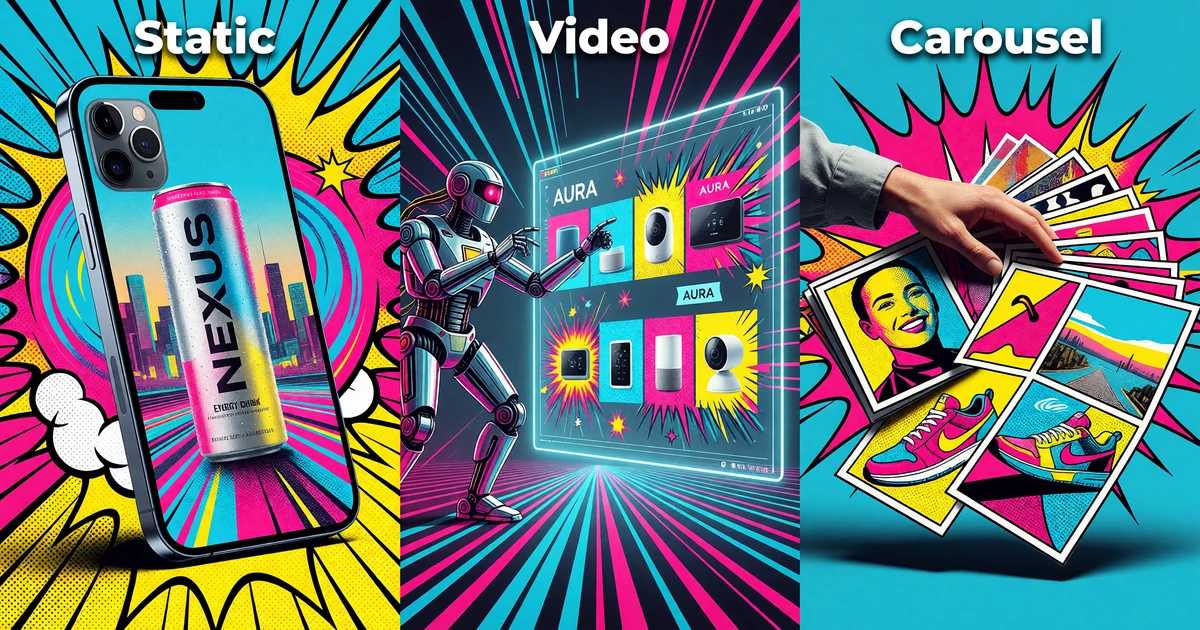
AI manages creative formats by treating static images, video, and carousel ads as production options inside a performance system, not as isolated design requests. The system chooses, tests, and improves each format based on audience intent, placement constraints, offer complexity, and conversion data.
That is the practical answer. The deeper answer is that creative format management becomes much easier when an AI agent can separate five variables: message, audience, offer, placement, and asset type. Static, video, and carousel are not competing religions. They are tools. The job is to know when each one should be produced, where it should run, and when it should be retired.
BattleBridge is built around that idea. We are not a traditional agency that waits for a monthly creative meeting, launches a campaign, and reports back after the budget is gone. We operate autonomous multi-agent systems across production marketing assets. Today that includes 10 deployed AI agents across 3 servers, 46 registered skills, a senior living directory with 977 cities, 51 states, and 4,757 community listings, a CRM with 8,442 contacts, and the EBL coaching platform.
Creative format management is one layer of that broader machine. If you want the operating model behind it, start with What Is Agentic Marketing? and Architecture of an Agentic Marketing System.
Creative Formats Are Decisions, Not Deliverables
Most agencies talk about formats as deliverables: three static ads, two videos, one carousel. That is a production mindset. It may be useful for billing, but it is not how performance works.
A marketing machine treats creative formats as decisions. The question is not, "Do we need a video?" The question is, "What is the fastest, clearest, highest-leverage format for this message, audience, and placement?"
That distinction matters because every format has a different cost profile.
Static Ads Are Fast Signal Capture
Static creative is still the fastest way to test positioning. A single image can validate a headline, offer angle, proof point, objection, or audience segment without waiting on video production.
Static is useful when:
- The offer is simple enough to understand in one frame
- The audience already knows the category
- The goal is to test message-market fit quickly
- The platform placement moves fast, such as feeds or display inventory
- Production speed matters more than narrative depth
In our own systems, static assets are often the first testing layer because they remove production drag. If the message does not work in a static ad, it usually does not deserve a video yet.
That does not mean static is basic. A strong static ad has to compress the entire argument into a tight visual hierarchy: audience cue, problem, offer, proof, action. AI helps by generating and ranking variations across those components instead of treating the image as a finished artifact.
Video Ads Are Compression Engines for Trust
Video is not automatically better. It is more expensive to produce, easier to overcomplicate, and often misused as a brand theater exercise.
Video earns its place when the buyer needs more context before acting.
It is useful when:
- The offer requires explanation
- The product or service benefits from demonstration
- The buyer has strong objections
- The founder, expert, or customer story creates trust
- The platform rewards attention depth
For BattleBridge, video becomes valuable when we need to show how the machine works. Explaining "10 deployed AI agents across 3 servers" in a static ad is possible, but it can feel abstract. Video can show the operational stack: agents running, skills executing, content moving through workflows, and production systems updating.
The best video ads are not just moving versions of static ads. They use sequence. They open with the problem, establish credibility, show the mechanism, and close with a specific action. AI agents can help map that structure, generate scripts, produce variants, and analyze where attention drops.
Carousel Ads Are Structured Arguments
Carousel is the most misunderstood of the three. Many teams use it as a dumping ground for extra images. That is weak.
A carousel should be a sequence. Each card should do a job.
Common carousel structures include:
- Problem, mechanism, proof, offer, CTA
- Before, process, after, proof, CTA
- Feature 1, feature 2, feature 3, comparison, CTA
- Audience segment 1, segment 2, segment 3, shared outcome, CTA
- Step 1, step 2, step 3, result, CTA
Carousel works well when the buyer needs comparison, education, or multiple proof points. It is especially useful for complex offers where one frame is too thin but full video is not necessary.
For example, a carousel for the USR senior living directory could show city coverage, state coverage, community listings, directory depth, and search intent. Those are concrete proof points: 977 cities, 51 states, 4,757 communities. Each card can carry one number and one implication.
That is much stronger than five cards saying the same thing with different backgrounds.
How an Agentic System Chooses the Right Format
A human creative director can make good format decisions, but the process usually lives in their head. That makes it hard to scale. Agentic marketing makes the decision process explicit.
At BattleBridge, we think in terms of agents, skills, and production systems. An agent does not just "make an ad." It evaluates the campaign context, pulls from available assets, understands the offer, checks prior performance, and decides what to generate next.
That is where ai creative formats become operational instead of theoretical.
The Agent Starts With the Job of the Ad
Before format comes job.
An ad might need to:
- Introduce a new category
- Capture high-intent demand
- Retarget a known visitor
- Explain a complex mechanism
- Prove credibility
- Segment an audience
- Push a direct offer
- Recover lost pipeline
Each job points toward a different format.
If the job is fast validation, static usually comes first. If the job is education, video becomes more useful. If the job is sequencing proof, carousel may be the right move.
This is the same logic behind Ads Arsenal - AI-Agent Ads Management. The point is not to produce more ads for the sake of volume. The point is to produce the right next asset faster than a human team can coordinate it manually.
The Agent Separates Message From Format
A common mistake is judging the format when the message is the real problem.
If a static ad fails, the answer is not always "make a video." The headline may be unclear. The offer may be weak. The audience may not care. The proof may be missing. The CTA may be too aggressive for the stage of intent.
A useful AI system separates these variables.
The system should be able to say:
- This message worked in static but not video
- This offer worked for retargeting but not prospecting
- This proof point increased qualified clicks but lowered total clicks
- This carousel had strong first-card engagement but weak final-card action
- This video earned attention but did not convert
That is how creative testing becomes cumulative. Each result improves the next production cycle.
The Agent Uses Production Cost as a Variable
Production cost is not just money. It is time, attention, review burden, and operational friction.
A 30-second video may have more expressive power than a static ad, but if it takes 12 people and three weeks, it is not always the right asset. An AI-first system should consider the cost of learning.
For a new offer, fast learning usually beats polished production. For a proven offer, higher-production video can make sense. For a complex but validated offer, carousel can bridge the gap.
The machine should not ask, "What can we make?" It should ask, "What is the cheapest reliable way to learn the next thing?"
That is a better operating question.
What BattleBridge Has Learned From Real Systems
The strongest argument for agentic marketing is not that AI can generate more content. It is that AI can manage connected systems where creative, CRM, SEO, and conversion data feed each other.
BattleBridge has production examples behind this.
USR: Format Depends on Search Intent
USR is a senior living directory with 977 city pages across 51 states and 4,757 community listings. That is not a campaign. It is a structured acquisition system.
The creative lesson from USR is simple: when the user has local intent, specificity beats broad messaging.
A static ad or landing page creative for "senior living in Phoenix" should not look like a generic national brand ad. It should reflect the city, the category, and the searcher's decision stage. A carousel can show care types, community counts, local considerations, and next steps. A video can explain how to compare options if the user needs education.
The format follows the intent.
This is the same principle behind our Programmatic SEO at Scale work. Scale only works when the system keeps the local details intact.
CRM: Creative Should Reflect Contact Reality
Our CRM contains 8,442 contacts. That matters because creative should not be built in isolation from pipeline reality.
If the CRM shows that a segment already knows the brand, the ad does not need to waste space explaining who we are. If contacts stall after an intro call, creative may need objection handling. If a list is cold, the system may need a simple static value proposition before asking for a meeting.
This is where many agencies underperform. They run creative from platform data alone. Platform data tells you clicks, impressions, and conversions. CRM data tells you whether those conversions were worth anything.
An AI agent that can see both has a better shot at choosing the right creative format.
Static might produce cheaper leads. Video might produce fewer but better calls. Carousel might pre-qualify prospects by explaining the system before they book. Without CRM feedback, the team may optimize for the wrong number.
EBL: Education Changes the Format Mix
The EBL coaching platform is different from a directory or CRM workflow. Coaching requires trust, clarity, and repeated exposure. That changes the creative mix.
For education-led offers, video and carousel usually carry more weight because the buyer needs to understand the framework before acting. Static still matters, but it often works best as a hook, reminder, or retargeting asset.
The format mix should follow the buying process. If the audience needs belief change, use formats that can build belief. If the audience already has intent, use formats that reduce friction.
That is the central discipline behind ai creative formats: match the asset type to the buyer's next required belief or action.
The Operating Model: From Brief to Learning Loop
A traditional creative workflow is linear. Brief, concept, design, review, launch, report. Then everyone argues about what happened.
An agentic workflow is circular. The system generates, launches, reads performance, updates memory, and produces the next variant.
Step 1: Define the Format Hypothesis
Every creative asset should have a hypothesis.
Examples:
- Static ad: "A direct proof-point image using 4,757 community listings will outperform a generic directory message for senior living searchers."
- Video ad: "A founder-led explanation of autonomous agents will improve qualified demo requests for BattleBridge."
- Carousel ad: "A five-card sequence explaining problem, mechanism, proof, system, and CTA will improve engagement for cold audiences."
The hypothesis gives the agent something to test. Without it, the system is just making content.
Step 2: Generate Variants With Controlled Differences
The system should not change everything at once. If every variation has a different headline, image, CTA, audience, and format, the result is hard to interpret.
Good testing isolates variables.
For static ads, that may mean three headline angles against one visual system. For video, it may mean testing hooks while keeping the body structure the same. For carousel, it may mean testing card order or proof points.
The goal is not maximum variation. The goal is interpretable variation.
Step 3: Evaluate More Than Clicks
Clicks are useful, but they are not enough.
A creative agent should look at:
- Click-through rate
- Cost per click
- Conversion rate
- Lead quality
- CRM progression
- Cost per qualified opportunity
- Format-specific engagement
- Drop-off points
- Placement performance
Video may lose on click cost but win on qualified pipeline. Static may win on speed but lose on depth. Carousel may look average in platform metrics but produce better-informed leads.
The evaluation model has to match the business model.
Step 4: Promote, Retire, or Rebuild
After testing, each asset needs a decision.
Promote means the asset earned more budget or more placements. Retire means the asset no longer deserves spend. Rebuild means the core idea is strong, but the execution needs a different format or structure.
This is where AI agents are especially useful. Humans often keep weak creative alive because of sunk cost. Machines do not care that a video took three days to produce. If it does not perform, it gets replaced.
That discipline is one reason AI-first agencies can move differently than traditional shops. We covered the broader distinction in AI Marketing Agency vs Traditional Agency.
Practical Rules for Static, Video, and Carousel
Here is the operating logic I would use if I were building a creative system from scratch.
Use Static When Speed Matters
Use static creative when you need fast signal. It is the best first layer for offer testing, headline testing, proof-point testing, and audience segmentation.
Static is also useful when the audience is already warm. If someone has visited a pricing page, downloaded a guide, or engaged with a specific topic, a clear static ad may outperform a long video because the buyer does not need the full story again.
A strong static ad should answer three questions quickly:
- Who is this for?
- What is the specific promise?
- Why should I believe it?
If it cannot answer those questions, changing the background image will not help.
Use Video When Understanding Matters
Use video when the buyer needs to understand the mechanism.
For BattleBridge, the mechanism is the marketing machine: autonomous agents, registered skills, production systems, and feedback loops. That is not always obvious from a headline. Video can show how the pieces connect.
Good video creative needs structure. The first three seconds should create relevance. The next section should explain the problem or mechanism. The proof should be concrete. The CTA should match the viewer's stage of intent.
Do not make video because the platform likes video. Make video because the buyer needs motion, sequence, demonstration, or trust.
Use Carousel When Sequence Matters
Use carousel when the argument needs steps.
Carousel is especially useful for:
- Explaining a system
- Comparing options
- Showing multiple use cases
- Breaking down a process
- Presenting proof points
- Segmenting different audiences
A good carousel has one idea per card. The first card earns the swipe. The middle cards build the argument. The last card makes the action obvious.
If every card can be rearranged without changing the meaning, the carousel is probably weak.
Let the System Reallocate Budget
The format mix should not be fixed.
A mature agentic marketing system should shift production and spend based on results. If static ads are producing clean qualified demand, make more static variants. If video is improving lead quality, produce more hooks and cuts. If carousel is pre-qualifying buyers, expand the sequence logic.
This is where ai creative formats become a compounding advantage. The system learns which format does which job for which audience, then uses that memory in the next round.
FAQ
Can AI manage video and static ads together?
Yes. AI can manage video and static ads together when the system tracks format, placement, message, audience, and outcome as separate variables instead of treating each ad as a one-off asset.
Which ad format performs best?
There is no universal best format. Static often wins on speed and clarity, video often wins on education and attention, and carousel often wins when the offer needs comparison or sequencing.
How does AI decide between video and image ads?
AI decides by matching the creative format to the intent, channel, cost, and observed performance. The agent should compare conversion quality, not just click-through rate.
Should you test carousel ads?
Yes, if your offer benefits from multiple proof points, product angles, steps, locations, or comparisons. Carousel ads are weak when each card repeats the same idea.
Does format matter more than message?
No. Format changes how a message is consumed, but it cannot rescue a weak offer, unclear positioning, or bad audience match.
Build the Machine, Not Just the Ads
Static, video, and carousel assets are not the strategy. They are outputs from a system that understands audience intent, offer complexity, production cost, and performance feedback.
That is the difference between running campaigns and building marketing machines.
BattleBridge builds AI-first marketing systems that can generate, test, learn, and improve across channels. If you want an agency that ships autonomous systems instead of another stack of campaign decks, start with BattleBridge Home or see how we approach Ads Arsenal - AI-Agent Ads Management.
Get Your Free AI Creative Formats Audit
BattleBridge runs autonomous AI agents that handle this end to end — research, content, distribution, and reporting — for a flat monthly rate instead of an agency retainer. We'll audit your current setup, show you exactly where agents outperform your existing stack, and hand you the findings whether you hire us or not.
Get your free audit — 30 minutes, no pitch deck, real numbers.