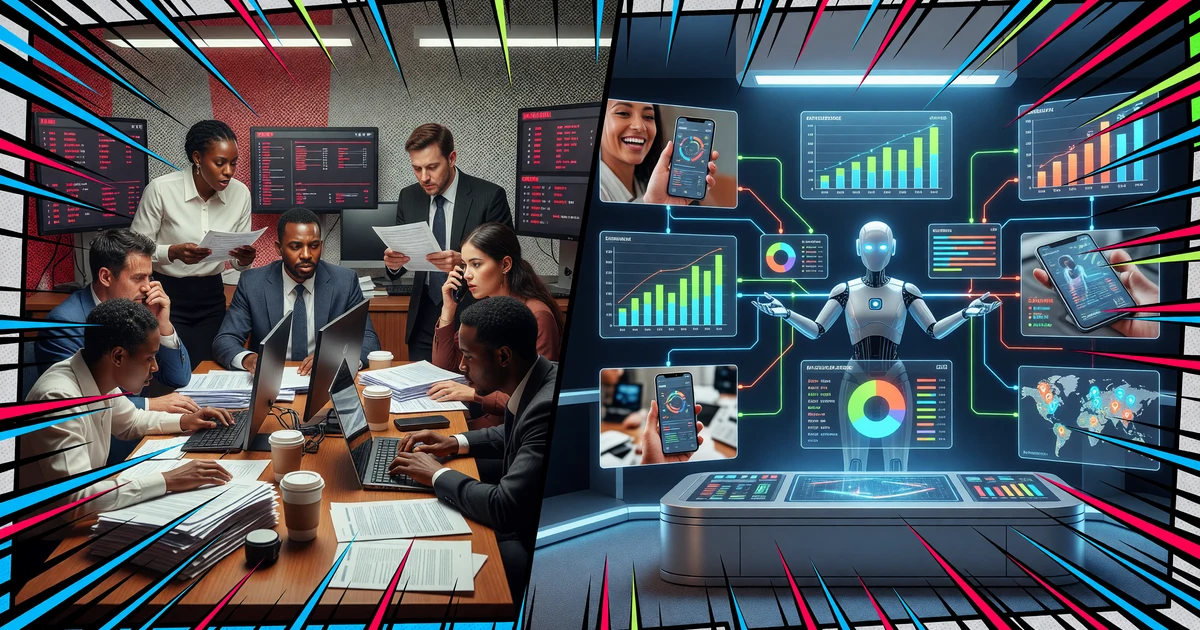
Traditional marketing agencies rely on human teams that create bottlenecks, inconsistencies, and coverage gaps. BattleBridge takes a different approach: we build autonomous AI agents that handle marketing operations continuously, delivering more consistent results at scale.
After 18 years in marketing, I've watched agencies promise results and deliver spreadsheets. The fundamental problem isn't talent or strategy—it's that human-driven marketing breaks when people leave, can't operate continuously, and doesn't scale efficiently.
What We Mean by AI Marketing Operations
Before diving into our approach, let's define what we mean by AI marketing operations. This isn't basic automation like scheduled social media posts or email sequences. We're talking about AI agents that make decisions, adapt to changes, and execute complex workflows with minimal human oversight.
Our AI agents handle tasks like:
- Content operations: Research, writing, optimization, and publishing
- CRM management: Lead scoring, nurturing sequences, and contact hygiene
- Local page generation: Creating and maintaining location-based content
- Performance monitoring: Tracking KPIs and adjusting strategies based on data
- Compliance oversight: Monitoring platform policy changes and adapting campaigns
Each agent operates within defined parameters but makes autonomous decisions about execution, timing, and optimization.
Why Traditional Agency Workflows Break Down
Most agencies operate on the "human multiplier" model: hire smart people, give them tools, hope for consistent output. This creates three critical problems:
Consistency Issues: Sarah optimizes Google Ads differently than Mike. When Sarah leaves, Mike inherits campaigns he didn't build. Performance drops while you restart the relationship.
Scale Limitations: Growing traditional agencies hire more people, creating communication overhead and more failure points. At 50+ employees, agencies spend more time managing themselves than delivering client results.
Coverage Gaps: Humans work 8-hour days, take vacations, and get sick. Meanwhile, your competitors' automated systems run 24/7, capturing opportunities you miss.
Consider the math: a $10,000/month agency retainer for managing 5 clients means $2,000 per client monthly. After overhead, tools, and profit margins, maybe $800 reaches actual marketing work. You're paying premium prices for part-time attention.
Platform policy changes add another complexity layer. Facebook updates advertising policies monthly. TikTok shifts policies with regulatory pressure. Traditional agencies assign one person to monitor these changes across multiple platforms—and when they miss updates, campaigns get disapproved and clients lose money.
What Our AI Marketing System Actually Does
Our approach replaces human execution with AI agents while keeping humans focused on strategy and oversight. This creates what we call "agentic marketing"—autonomous systems that operate independently within defined workflows.
Real Production Example: Senior Living Directory
Our most visible system demonstrates this approach in action. We built a senior living directory that AI agents populate and maintain automatically:
- Content agent researches and writes unique descriptions for each facility
- SEO agent optimizes pages for local search terms and monitors rankings
- Data agent updates availability, pricing, and amenities from facility websites
- Monitoring agent tracks performance and identifies optimization opportunities
The content agent generated landing pages for hundreds of cities in two weeks—work requiring months for traditional teams. More importantly, it maintains content quality and SEO optimization across all pages continuously.
CRM Operations at Scale
Our CRM agent demonstrates autonomous lead management. It processes thousands of contacts across different industries, personalizing outreach based on behavior patterns:
- Recent website visitors get immediate, relevant follow-up
- Content downloads trigger educational email sequences
- Pricing page visits activate sales-focused messaging
- Long-term prospects enter re-engagement campaigns
This level of personalization and speed typically requires dedicated teams. Our agent handles it as background processing while continuously optimizing conversion rates based on performance data.
Compliance and Policy Monitoring
Platform advertising policies change frequently, and manual monitoring creates risk. Our compliance agents track policy updates across major platforms and automatically adjust campaigns to maintain approval rates.
When Facebook restricted health claims in senior living ads, our agents identified affected campaigns, rewrote ad copy to comply with new policies, and maintained high approval rates while competitors faced mass disapprovals.
Evidence and Results
Unlike agencies that hide behind vanity metrics, our system tracks business outcomes:
- Revenue generated, not just traffic increases
- Customer lifetime value, not just conversion rates
- Profit margins, not just return on ad spend
- Retention rates, not just acquisition costs
This transparency creates better decision-making. When our PPC agent reports that Facebook ads generate leads at $45 each but Google ads convert at higher lifetime value despite $65 acquisition costs, clients can make informed budget decisions.
Performance Metrics
Our agents operate with measurable improvements over traditional approaches:
- Content generation: 10x faster than human writers while maintaining quality
- SEO optimization: Continuous monitoring vs. monthly manual reviews
- Lead response: Immediate automated follow-up vs. business-hours delays
- Policy compliance: Proactive adjustments vs. reactive damage control
How Human Oversight Works
Despite autonomous operation, humans remain essential for strategy, creativity, and exception handling. Our model includes several oversight layers:
Strategic Planning: Humans set goals, define target audiences, and establish brand guidelines that agents operate within.
Quality Review: Regular audits ensure agent output meets standards and brand requirements.
Exception Handling: Complex situations or edge cases get escalated to human team members for resolution.
Performance Analysis: Humans interpret results and adjust agent parameters to improve outcomes.
This structure handles defined workflows autonomously while maintaining human oversight for strategic decisions and quality control.
Implementation Process
Deploying our AI marketing system involves three phases:
Phase 1: Assessment and System Design (Weeks 1-2)
We audit existing marketing operations to identify automation opportunities, review current workflows and data sources, and design custom agent configurations for specific business needs.
Phase 2: Agent Development and Testing (Weeks 3-4)
We build and train agents on client-specific requirements, configure decision-making parameters and safety limits, and test agents in controlled environments before production deployment.
Phase 3: Deployment and Optimization (Ongoing)
Agents go live with continuous monitoring, learn from performance data to optimize operations, and add new capabilities as opportunities emerge.
Most clients see initial results within 2-3 weeks, with full autonomous operation achieved within 60-90 days.
Competitive Advantages
This approach creates several sustainable advantages:
Operational Leverage: One set of agents handles multiple clients simultaneously without performance degradation, impossible with human teams that scale linearly.
Consistency: Agents maintain quality standards across all work without variation due to mood, experience level, or competing priorities.
Continuous Operation: 24/7 monitoring and optimization means capturing opportunities competitors miss during off-hours.
Rapid Adaptation: Agents respond to market changes, policy updates, and performance data in real-time rather than waiting for monthly reviews.
Investment in Marketing Technology
Our pricing reflects the value of autonomous operation rather than billable hours. Initial deployments require investment in custom agent development, but ongoing costs remain stable regardless of workload increases.
Traditional agencies can't compete on this model because their costs scale with client growth. Adding clients means hiring more people. Our agents handle expanded workload without proportional cost increases, creating sustainable value for long-term partnerships.
The Future of Marketing Operations
The shift toward AI-driven marketing execution is accelerating. Companies using autonomous marketing agents consistently outperform traditional agency relationships on speed, consistency, and cost-effectiveness.
Early adopters gain competitive advantages that become difficult to replicate as markets mature. The question isn't whether this transition will happen—it's whether your business will lead or follow.
Ready to explore AI marketing operations for your business? Contact BattleBridge to discuss implementing autonomous marketing agents for your specific needs, or explore investment opportunities to participate in the future of marketing technology.
Frequently Asked Questions
What is AI marketing operations in the BattleBridge approach?
AI marketing operations at BattleBridge means autonomous AI agents that make decisions, adapt to changes, and execute marketing workflows with minimal human oversight. Instead of simple automation, the agents handle content operations, CRM management, local page generation, performance monitoring, and compliance oversight within defined parameters.
How is BattleBridge different from a traditional marketing agency?
BattleBridge replaces most human execution with autonomous AI agents while keeping humans focused on strategy, quality review, and exception handling. That model reduces the bottlenecks, inconsistency, and limited coverage that happen when traditional agencies depend on people working fixed hours across multiple clients.
Can AI agents really manage marketing tasks like content, CRM, and compliance?
Yes, BattleBridge’s system is designed for exactly that: different agents handle content creation and publishing, lead scoring and nurture sequences, local SEO page maintenance, KPI monitoring, and policy compliance. The article’s examples include a senior living directory maintained by multiple agents and compliance agents that adjusted ad copy when Facebook policy rules changed.
How does human oversight work if the marketing system is autonomous?
Humans still set goals, define audiences, establish brand guidelines, review quality, and handle edge cases that need judgment. The agents run day-to-day execution autonomously, but people provide strategic direction and adjust parameters based on performance analysis.
How long does it take to implement BattleBridge’s AI marketing system and see results?
BattleBridge describes a three-phase process: assessment and system design in weeks 1-2, agent development and testing in weeks 3-4, and then ongoing deployment and optimization. Most clients see initial results within 2-3 weeks, with full autonomous operation typically reached within 60-90 days.