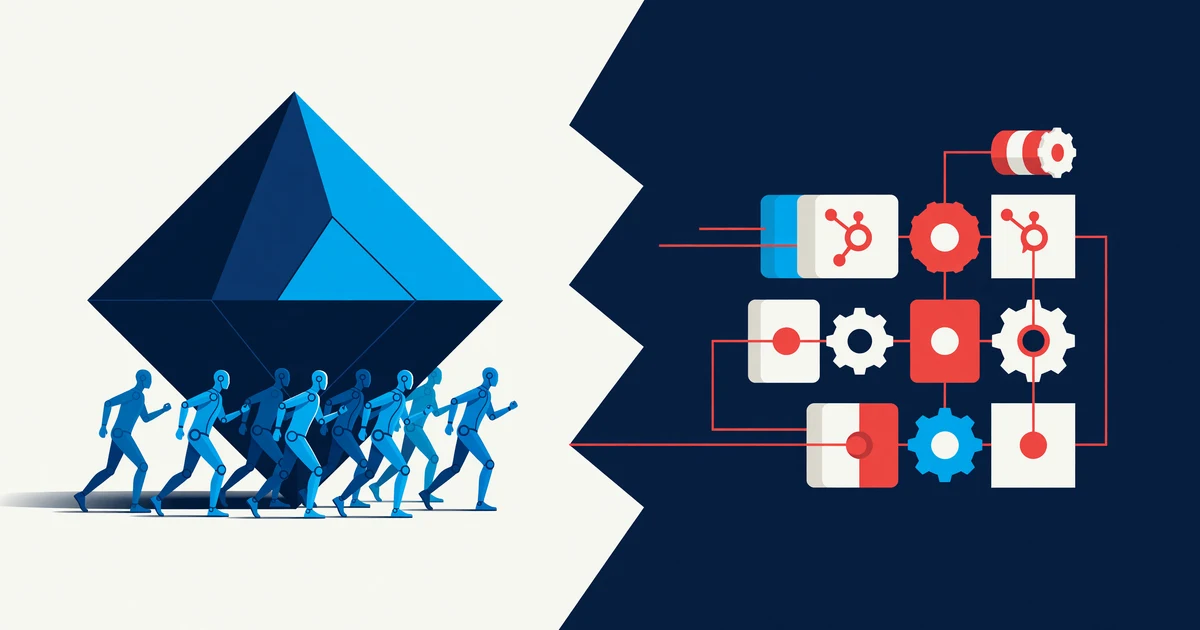
Marketing automation platforms like HubSpot excel at streamlining human-managed marketing processes, while AI marketing agencies can deploy autonomous agents that adapt strategies based on performance data. The choice often depends on whether you need enhanced workflow management or autonomous decision-making capabilities.
Both approaches serve different business needs. This comparison examines the practical differences, limitations, and ideal use cases for each option to help you determine which fits your marketing requirements.
Key Terms and Definitions
Autonomous agents: AI systems that can analyze data, make strategic decisions, and execute marketing tasks with minimal human oversight. These systems adapt their approach based on performance feedback.
Marketing automation: Software that executes predefined workflows and sequences based on trigger conditions. Examples include sending email sequences when prospects take specific actions.
Workflow management tools: Platforms that organize, schedule, and execute marketing tasks according to human-programmed rules and conditions.
Decision-Making: Adaptive Intelligence vs Rule-Based Automation
AI Agent Capabilities
AI marketing agencies can build systems that analyze performance data and adjust strategies autonomously. For example, an AI agent might identify that certain content types perform better in specific geographic markets and automatically adjust content creation accordingly.
These systems often use machine learning to identify patterns in user behavior and optimize campaigns based on real-time data analysis.
HubSpot's Automation Approach
HubSpot excels at executing sophisticated rule-based workflows. When a prospect downloads specific content, the system can trigger personalized email sequences, update contact properties, and alert sales teams based on predefined conditions.
However, strategic pivots, creative development, and campaign optimization typically require human analysis and manual updates to workflows.
Content Strategy: Generation vs Distribution
AI Agency Content Operations
Some AI marketing agencies can generate original content, analyze performance patterns, and iterate on messaging strategies. These systems might create city-specific landing pages, optimize headlines based on engagement data, or develop content variations for A/B testing.
HubSpot Content Management
HubSpot provides robust content distribution capabilities, including email personalization, social media scheduling, and dynamic content delivery. The platform excels at organizing content workflows and personalizing distribution based on contact properties.
Content creation, strategic messaging, and campaign optimization generally require human input, though HubSpot can automate the distribution and personalization processes.
Technical Architecture Comparison
Coordination Capabilities
AI marketing agencies often deploy multiple specialized agents that can coordinate tasks. For instance, an SEO analysis agent might identify keyword opportunities and share findings with a content creation agent, which then produces optimized content.
HubSpot workflows handle complex sequences through carefully designed automation chains. Teams can create sophisticated nurture sequences that respond to user behavior, but connecting multiple workflows for complex strategies requires manual setup and ongoing management.
Learning and Adaptation
Some AI systems can improve performance through machine learning, identifying successful patterns and applying them to future campaigns. This can include optimizing send times, refining audience targeting, or improving content performance.
HubSpot automation follows programmed logic consistently until humans manually update the workflows. The platform provides detailed analytics to inform these updates but doesn't automatically modify strategies based on performance data.
Use Case Scenarios
Content Operations at Scale
AI Agency Strength: Generating large volumes of localized or personalized content programmatically while maintaining quality and optimization.
HubSpot Strength: Distributing existing content through sophisticated personalization and targeting workflows.
Lead Nurturing
AI Agency Approach: Can adapt messaging and timing based on individual prospect behavior patterns and performance data.
HubSpot Approach: Excels at complex, branching nurture sequences based on predetermined criteria and contact properties.
Reporting and Analytics
AI Agency Capability: Can analyze performance data and automatically adjust strategies based on findings.
HubSpot Capability: Provides comprehensive reporting dashboards and can trigger actions based on specific metrics, but strategic changes require human analysis.
Limitations and Considerations
AI Agent Limitations
- Quality control requires ongoing monitoring to prevent errors or brand inconsistencies
- Initial setup can be complex and may require specialized technical expertise
- AI-generated content may need human review for accuracy and brand alignment
- Performance depends heavily on data quality and system training
HubSpot Limitations
- Requires dedicated team members to develop strategies, create content, and optimize campaigns
- Workflows need manual updates to adapt to changing market conditions or performance data
- Strategic thinking and creative development remain human-dependent
- Complex implementations may require significant training and ongoing management
Cost and Implementation Analysis
HubSpot Investment Structure
HubSpot's Marketing Hub Professional starts around $800 monthly, with Enterprise features requiring higher subscription tiers. Total cost includes software licensing, team training, ongoing management, and the human resources needed for strategy development and content creation.
Implementation typically requires 2-4 weeks for basic setup, with ongoing optimization depending on team expertise and campaign complexity.
AI Marketing Agency Partnership
AI agency partnerships often range from $5,000-15,000+ monthly, depending on scope and complexity. This may include system development, ongoing optimization, and varying levels of human oversight.
Setup time can range from 4-12 weeks, depending on integration requirements and system complexity.
Decision Framework
| Factor | Choose AI Agency When | Choose HubSpot When |
|---|---|---|
| Team Resources | Limited marketing team, need autonomous operation | Strong marketing team needing better organization |
| Content Needs | High-volume, programmatic content creation | Distribution of human-created content |
| Strategic Control | Comfortable with AI-driven strategy adaptation | Prefer maintaining direct strategic oversight |
| Technical Expertise | Have or can access AI implementation expertise | Need user-friendly platform for existing team |
| Scale Requirements | Rapid scaling without proportional team growth | Organized growth with expanded team capabilities |
Hybrid Approaches
Many companies use both approaches strategically. HubSpot can handle CRM integration, sales alignment, and structured workflows, while AI agents manage specific functions like content generation or performance optimization.
Implementation Recommendations
For AI Marketing Agency Selection
- Evaluate specific agent capabilities and track record
- Understand quality control processes and human oversight levels
- Clarify data requirements and integration complexity
- Establish performance metrics and optimization processes
For HubSpot Implementation
- Assess team training requirements and change management needs
- Plan workflow complexity based on current team capabilities
- Consider integration requirements with existing systems
- Budget for ongoing management and optimization resources
Conclusion
The choice between AI marketing agencies and HubSpot often comes down to operational philosophy: enhanced human management versus autonomous marketing intelligence. HubSpot remains powerful for teams wanting sophisticated workflow management and CRM integration. AI agencies offer autonomous capabilities that can operate independently of day-to-day human oversight.
Consider your team structure, technical requirements, control preferences, and growth objectives when making this decision. The most effective approach aligns with your operational capacity and strategic marketing goals.
For companies ready to explore autonomous marketing capabilities, evaluate AI agency partnerships based on specific use cases, proven results, and integration requirements. Those preferring enhanced human-managed processes will find HubSpot's comprehensive platform supports sophisticated marketing operations with proper team investment.
Frequently Asked Questions
What is the main difference between an AI marketing agency and HubSpot?
An AI marketing agency uses autonomous agents that can analyze performance data, adjust strategy, and execute marketing tasks with minimal human oversight. HubSpot is a marketing automation platform that runs predefined workflows well, but strategy changes and optimization usually still require human intervention.
When should a business choose an AI marketing agency instead of HubSpot?
A business should choose an AI marketing agency when it needs autonomous decision-making, programmatic content creation, or rapid scaling without adding proportional team capacity. This is especially relevant when the team is small, the content volume is high, and the company is comfortable with AI-driven adaptation.
Can HubSpot do the same things as autonomous AI agents?
HubSpot can automate sophisticated workflows, personalize distribution, and trigger actions based on user behavior or contact properties. It does not usually make strategic pivots, create original campaign direction, or automatically change workflows based on performance data the way autonomous agents can.
How do content creation and distribution differ between AI marketing agencies and HubSpot?
AI marketing agencies can support content generation, messaging iteration, and performance-based optimization across content variants. HubSpot is stronger at distributing and personalizing existing content through email, social scheduling, and workflow-based targeting.
Is it better to use HubSpot and an AI marketing agency together?
Yes, a hybrid approach can make sense when a company wants both structured workflow management and autonomous optimization. In that model, HubSpot can handle CRM, sales alignment, and workflow orchestration while AI agents manage tasks like content generation or performance-based campaign improvements.