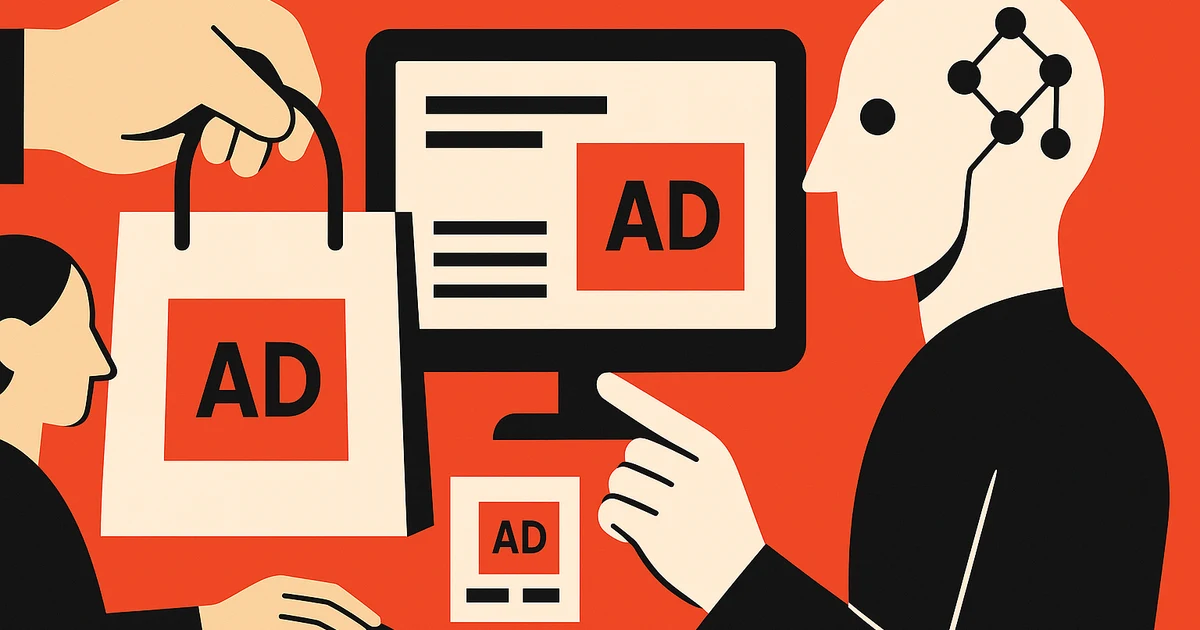
White label AI ad management lets an agency sell autonomous campaign operations under its own brand without building every monitoring, analysis, reporting, and optimization workflow from scratch. The agency owns the client relationship and strategy; governed AI agents execute defined tasks, surface exceptions, and prepare or apply approved changes within account-level limits.
The product is not an unsupervised bot with access to a client’s advertising budget. It is a controlled operating system for paid media: specialized agents, connected data, explicit decision rights, audit trails, and human escalation. Done correctly, it gives an agency more delivery capacity without forcing account quality to depend on how many dashboards one media buyer can check before lunch.
What the agency is actually reselling
The client is not buying “AI” as an abstract feature. The client is buying an outcome: campaigns that are watched consistently, adjusted according to agreed rules, and explained in language that connects advertising activity to business results.
The underlying system can perform repeatable work such as:
- Checking spend, pacing, conversion volume, and cost trends
- Flagging campaigns that move outside approved thresholds
- Finding search terms, audiences, placements, or creatives that need review
- Preparing budget and bid recommendations
- Detecting broken tracking or sudden data loss
- Generating branded performance summaries
- Routing high-risk decisions to a human operator
- Recording what changed, when it changed, and why
That distinction matters. A generic AI assistant produces answers when prompted. An autonomous advertising system observes accounts continuously, maintains state, follows operating policies, and takes the next permitted action.
BattleBridge built its infrastructure around that model. Our production environment includes 10 deployed AI agents distributed across three servers and 46 registered skills. Each agent has a defined job, inputs, tools, and escalation path. The same architectural principle can be applied to media operations: divide the work by responsibility instead of asking one general-purpose model to behave like an entire agency.
The difference between conventional outsourcing and an agent-based service is operational, not cosmetic.
| Capability | Traditional white-label team | Single AI assistant | Governed multi-agent system |
|---|---|---|---|
| Account monitoring | Scheduled manual checks | Runs when prompted | Continuous scheduled checks |
| Decision process | Depends on individual buyer | Generated in one conversation | Enforced through policies and specialized roles |
| Scalability | Requires more staff | Faster output, limited continuity | Adds accounts through repeatable workflows |
| Institutional memory | Stored in people and documents | Often session-dependent | Maintained in structured account state |
| Quality control | Manager review | User reviews every response | Automated checks plus human escalation |
| Reporting | Manually assembled | Drafted from supplied data | Generated from connected, validated sources |
| Change authority | Assigned to media buyers | Often ambiguous | Explicit limits by action and risk |
| Auditability | Notes and platform history | Inconsistent | Decision and action logs by default |
This is the operating model behind Ads Arsenal — AI-Agent Ads Management. The agency-facing opportunity is to turn that infrastructure into a productized service with consistent scope, pricing, and delivery standards.
How white-label ad automation works
A reliable system separates observation, analysis, authorization, execution, and reporting. Combining all five into one prompt creates an accountability problem: the same process identifies an issue, decides what it means, approves its own recommendation, makes the change, and describes the result.
That is not autonomy. It is concentrated risk.
1. The agency defines the campaign policy
Every account begins with a written operating policy. It should identify the primary conversion, acceptable cost range, budget limits, geographic restrictions, brand exclusions, protected campaigns, and actions that always require approval.
The policy also defines the account’s risk levels. Pausing a search term that has spent a small amount without a conversion is different from reallocating half the monthly budget. Those decisions should not have the same authorization threshold.
A useful control matrix has three lanes:
- Automatic: Low-risk, reversible actions within narrow limits
- Approval required: Material budget, targeting, bidding, or creative changes
- Human only: Strategy changes, offer changes, account restructuring, and decisions involving legal or brand risk
2. Specialized agents monitor separate signals
One agent can watch budget pacing while another checks conversion tracking. A third can analyze search terms, and a fourth can assemble the client report. Separation creates clearer ownership and makes failures easier to diagnose.
BattleBridge’s broader production systems demonstrate why specialization matters. Our senior living directory operates across 977 cities and 51 states with 4,757 community listings. Our CRM contains 8,442 contacts. Those are not demo records created for a sales presentation; they are operating systems with enough volume to expose weak workflows, missing state, and unreliable automation.
The lesson transfers directly to advertising. Once an agency manages dozens of accounts, memory cannot live in a strategist’s inbox. Account rules, prior decisions, exceptions, and current objectives need structured storage.
3. The system validates data before recommending changes
An agent should not optimize toward a conversion event it has not verified. Before making recommendations, the system needs to check whether required data is present, recent, and internally consistent.
For example, a sudden fall in reported leads could indicate weaker traffic, a broken form, an expired integration, a changed attribution setting, or delayed platform reporting. Cutting bids before distinguishing among those causes can turn a tracking failure into a revenue failure.
Validation rules should cover:
- Missing or stale conversion data
- Abnormal differences between ad-platform and CRM totals
- Campaigns spending outside approved schedules
- Changes to landing-page availability
- Unrecognized edits made outside the system
- Insufficient data for the requested decision
When confidence is low, the correct autonomous action is escalation.
4. Approved actions move through a controlled execution layer
The execution layer translates an approved decision into a platform action. It should enforce hard limits independently of the agent that proposed the change.
If the account policy allows budget adjustments of no more than 10% in one cycle, the execution layer should reject a 25% increase even if the recommendation sounds persuasive. The control belongs in code and policy, not in the model’s memory.
Every action should produce a record containing the account, campaign, previous state, new state, reason, authorizing rule, timestamp, and rollback path. That history lets the agency explain results without reconstructing the month from scattered platform logs.
For a deeper look at this division of responsibilities, see The Architecture of an Agentic Marketing System.
5. The agency delivers the result under its brand
The client-facing layer can use the agency’s name, terminology, reporting format, and service process. Reports should explain what happened, why it mattered, what changed, and what requires a decision.
A useful report does not celebrate impressions while qualified leads decline. It connects media performance to the funnel:
- Spend
- Clicks or visits
- Tracked conversions
- Qualified opportunities
- Pipeline value or revenue, when available
The agency still owns the strategic interpretation. Automation reduces the labor required to collect evidence and operate the account; it does not eliminate responsibility.
The economics of autonomous campaign delivery
The margin opportunity comes from reducing variable delivery labor while keeping strategy, controls, and client service strong. It does not come from hiding cheap software behind an expensive retainer.
Calculate gross margin account by account:
Gross margin = (recurring service revenue − direct delivery cost) ÷ recurring service revenue
If service revenue is three times direct delivery cost, gross margin is 66.7% before general overhead. That is arithmetic, not a promised industry benchmark. The agency must measure its own costs rather than copy a margin claim from a vendor deck.
Ad spend should normally remain separate from service revenue. Mixing the two obscures delivery economics and makes account comparisons less useful.
Direct cost breakdown
| Cost category | What belongs in it | Primary cost driver | How automation changes it |
|---|---|---|---|
| Platform infrastructure | Agent runtime, storage, APIs, monitoring | Accounts, data volume, execution frequency | Creates a measurable software cost per account |
| Account setup | Connections, policies, naming, baseline validation | Initial complexity | Templates reduce repeated configuration work |
| Human strategy | Goals, offers, channel mix, account direction | Business complexity | Remains human-led |
| Approval review | Material changes and exceptions | Risk level and account volatility | Agents filter routine activity from real decisions |
| Creative production | Copy, images, variants, landing-page input | Testing cadence | Accelerates drafts but still needs brand control |
| Client service | Meetings, explanations, planning | Service tier | Better records shorten preparation time |
| Quality assurance | Data checks, action audits, report validation | Number of integrations and changes | Automated checks make QA systematic |
| Software support | Maintenance, failed jobs, platform changes | Workflow maturity | Shared infrastructure spreads cost across accounts |
The strongest margin improvements usually come from compressing repetitive work: dashboard review, pacing checks, report assembly, anomaly triage, and routine analysis. Strategy, creative judgment, and client leadership should not be removed merely because they are expensive. Those are often the parts the client values most.
Capacity also matters. A conventional agency eventually reaches a point where each new group of accounts requires another buyer or account manager. An agent-based operation can move that threshold by standardizing the work between strategic decisions. It still needs humans, but headcount no longer has to rise in direct proportion to every recurring task.
How to package and sell the service
Start with one defined offer, not a menu of loosely connected AI features. The cleanest product specifies the supported channels, reporting cadence, optimization frequency, approval process, onboarding requirements, and exclusions.
Define the service boundary
A sellable package should state:
- Which advertising platforms are supported
- Whether the agency manages one account or multiple business units
- Which conversions must be available
- How often the system evaluates performance
- Which actions can run automatically
- Which changes require client or agency approval
- How creative and landing-page work are handled
- What happens when tracking fails
- How quickly critical exceptions are escalated
Do not promise “fully autonomous ads” if every meaningful change still waits in a shared inbox. Conversely, do not grant unrestricted execution rights just to make the service sound advanced. Controlled autonomy is a stronger product because the client can understand where the boundaries are.
Sell the operating system, not cheaper labor
The positioning should focus on consistency, speed, visibility, and accumulated operational knowledge. The agency is replacing fragmented manual routines with a documented system that does not forget to check pacing, lose last month’s decision, or skip an account because another client became urgent.
BattleBridge was founded by Travis Phipps after more than 18 years in marketing. That experience shaped a simple conclusion: campaigns are temporary, but operating systems compound. A campaign can produce a good month. A marketing machine preserves what worked, detects what changed, and turns the next decision into a repeatable process.
That is also the difference explored in AI vs. Traditional Marketing Agency: adding AI tools to an old staffing model is not the same as redesigning delivery around agents.
Protect trust with explicit governance
The service agreement should disclose that automation is used and define how it is governed. Clients do not need every internal implementation detail, but they should know who controls their accounts, how their data is handled, which actions require approval, and who is accountable when something goes wrong.
The agency should also retain independent administrative access, change logs, rollback procedures, and a documented offboarding process. White-label delivery changes the brand presented to the client; it does not erase operational responsibility.
Frequently asked questions
Can agencies white-label AI ad management?
Yes. Agencies can package white label AI ad management under their own brand while an AI operations layer handles defined campaign tasks behind the scenes. The agency remains responsible for strategy, client communication, approvals, and results.
How does white-label ad automation work?
The agency connects approved advertising accounts and data sources to a governed system of specialized agents. Those agents monitor performance, identify exceptions, prepare changes, enforce account rules, and generate branded reports according to a documented operating policy.
Does the client know AI is running their ads?
The agency should disclose the use of automation in its agreement and explain how human oversight, data access, and approvals work. The service can carry the agency’s brand without misrepresenting how campaigns are operated.
What margin can an agency keep on white-label AI ads?
There is no universal margin because media complexity, service scope, software costs, and human review vary. If recurring revenue equals three times direct delivery cost, gross margin is 66.7% before overhead; agencies should calculate their own margin from measured delivery costs.
Can an agency offer AI ad management under its own brand?
Yes. A white label AI ad management provider can supply the operating infrastructure while the agency controls positioning, pricing, client experience, and strategic direction. The contract should clearly define responsibilities, data handling, approval authority, and platform access.
Build My Agency’s Autonomous Ad Operation
See how Ads Arsenal can give your agency a governed, brand-ready operating layer for paid media. No unrestricted bot access and no need to replace the client relationships you already own.
Get Your Free White Label AI Ad Management Audit
BattleBridge runs autonomous AI agents that handle this end to end — research, content, distribution, and reporting — for a flat monthly rate instead of an agency retainer. We'll audit your current setup, show you exactly where agents outperform your existing stack, and hand you the findings whether you hire us or not.
Get your free audit — 30 minutes, no pitch deck, real numbers.